
How to Measure Stairs for Carpet
A staircase is not an area you cover - it is a runner that wraps each step. Here is how to measure stairs for carpet: count the steps, measure one tread and riser, allow for the nosing and winders, and turn it into a runner length.
By the Calculate My Reno Team / Published
Skip to the tool
Open the Carpet Calculator
Stairs trip people up because they are not an area to cover - they are a runner that wraps over the front of each step and down its face. So you do not measure a staircase in square feet; you measure the length of carpet it takes to follow the steps, and the width of the stair.
What to measure
- Count the steps. Every tread that gets carpet is one step. Include a half-landing or winder treads.
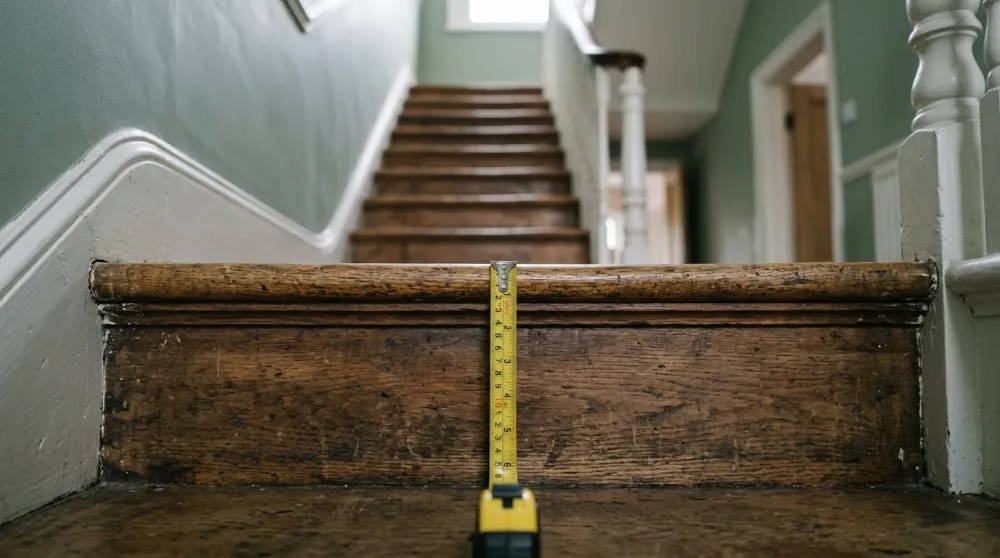
- Measure one step. Run the tape from the back of the tread, forward over the nosing (the lip at the front), and straight down the riser to the tread below. That length is the carpet per step. If you measure them separately, it is the tread (going) + the riser.
- Measure the stair width. How wide the carpet has to be across the step - usually a bit under a metre for a domestic flight.
carpet per step = tread (going) + riser   (+ a little for the nosing wrap)
runner length   = steps × carpet per step
Worked example
A straight flight of 13 steps, 250 mm tread and 200 mm riser, 0.9 m wide:
- Per step: 0.25 + 0.20 = 0.45 m.
- Runner: 13 × 0.45 = 5.85 m.
- Add wastage and the nosing wrap (about 10%): roughly 6.5 m of runner, 0.9 m wide.
Enter the steps, tread, riser and width as a staircase in the carpet calculator and it works the runner out and adds it to your rooms.
Watch out for
- Winders and landings. Curved winder treads need the carpet measured at the widest part of the tread, and a half-landing is an extra piece - measure it as its own small area.
- The nosing. Carpet wraps over the lip at the front of each tread, so add a little per step. The wastage allowance usually covers it, but on a long flight measure one step over the nosing to be sure.
- Pile direction. Carpet on stairs should run with the pile sweeping down the flight, so it wears and brushes the right way - this fixes which way the runner is cut and is why a stair runner is never seamed across the steps.
- Full width vs runner. A fully carpeted stair takes the whole stair width; a centred runner with painted edges takes less, but you still order by the runner length.
After the stairs
Add the landing and the rooms they connect to, and let the calculator pool the runs. Then size the underlay and the rest of the job - stair fitting is usually charged per step on top of the room rate, because it is slow, careful work.
Frequently asked questions
How do you measure stairs for carpet?
Count the steps, then measure one step from the back of the tread, over the nosing, and down the riser to the next tread - that is the carpet length per step. Multiply by the number of steps for the runner length, and measure the stair width separately. A 13-step flight at about 0.45 m per step needs roughly 5.85 m of runner. Enter the steps, tread, riser and width in the carpet calculator and it does the maths.
How much carpet do I need for 13 stairs?
With a typical 250 mm tread (going) and 200 mm riser, each step takes about 0.45 m of carpet, so 13 steps need about 5.85 m of runner - call it 6.5 m with wastage and the nosing wrap. A 16-step flight with deeper steps can need 7.5 m or more. Measure your own tread and riser, because they vary, and add a little for the nosing.
Do you measure carpet for stairs in the roll width?
The runner runs down the flight, and the roll width sits across the stair width. Because a stair is usually under a metre wide and the roll is 3.66 m, several stair widths can be cut side by side from one roll width - so you order the runner length, and a fitter nests the widths. The carpet calculator gives the runner length and pools it with your rooms.