
Mortar vs Concrete
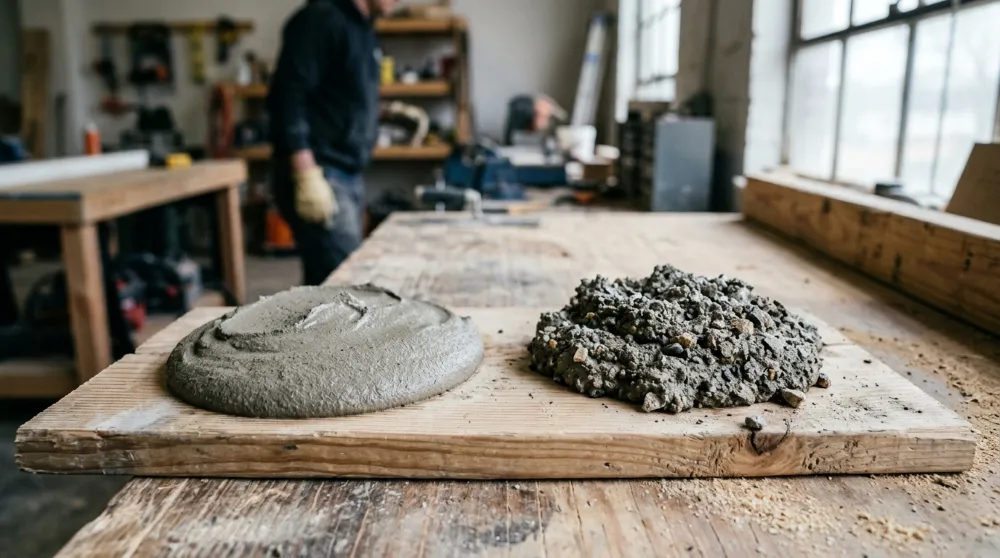
Mortar, concrete and cement are not the same thing. Cement is the glue; mortar is cement and sand for bonding brick and block; concrete adds gravel for structural strength. Here is how they differ and when to use each.
By the Calculate My Reno Team / Published
Skip to the tool
Open the Brick & Block Calculator
People use mortar, concrete and cement interchangeably, but they are three different things. Getting them straight matters, because using the wrong one means a wall that will not bond or a footing that will not hold.
The one-line difference
- Cement is the binder - the grey powder that, with water, glues everything together. You do not build with it alone.
- Mortar is cement + sand (often with lime). It is workable and sticky, made to bond brick and block and fill the joints.
- Concrete is cement + sand + gravel. The coarse aggregate makes it structural - strong in compression, for slabs, footings and posts.
How they compare
| Mortar | Concrete | |
|---|---|---|
| Aggregate | Sand only | Sand + coarse gravel |
| Strength | Lower (750 to 2,500 psi by type) | Higher (3,000 to 4,000+ psi) |
| Job | Bonding brick and block, joints | Structural slabs, footings, posts |
| Mix consistency | Plastic, buttery | Stiff, pourable |
| Where it goes | Between the units | Under and around the wall |
When to use which
- Laying brick or block? Use mortar - see how much mortar do I need for the type (N, S, M) and the amount.
- Pouring the footing or slab the wall sits on? Use concrete - size it with the concrete calculator, or mix your own with the concrete mix calculator.
- Filling the cores of reinforced block or the gaps between tiles? That is grout - a more fluid mix that flows into a void, where mortar holds units apart.
A typical brick wall uses both
A brick or block wall is the classic case where you need both: a concrete footing poured first to carry the load and spread it onto the ground, then mortar to bed and bond the units on top. Get the footing in concrete and the wall in mortar, and do not try to swap one for the other.
For the wall itself, see how many bricks do I need and how many concrete blocks do I need.
Frequently asked questions
What is the difference between mortar and concrete?
Concrete contains coarse gravel (aggregate) and is a structural material - it is strong in compression and used for slabs, footings and posts. Mortar has no gravel: it is cement, sand and water (sometimes lime), made to be workable and to bond brick and block together. Concrete is mixed stiff and poured; mortar is mixed plastic and buttered onto units.
Is cement the same as mortar or concrete?
No - cement is one ingredient, the powder that binds the others. Mortar is cement plus sand; concrete is cement plus sand plus gravel. So you use cement to make mortar or concrete, but you would not build with cement on its own.
Can I use concrete instead of mortar to lay brick?
Not really - the gravel in concrete makes it too coarse and stiff to spread on a thin bed and butter onto a brick, and it does not bond or tool the same way. Use mortar to lay brick and block. Use concrete for the footing the wall sits on, not for the joints.
What is the difference between mortar and grout?
Mortar is a stiffer mix that beds and bonds masonry units. Grout is a more fluid mix (sometimes with fine aggregate) that is poured or pumped to fill cavities - the cores of reinforced block, or the gaps between tiles. Mortar holds units apart and bonds them; grout flows in to fill a void.