
Vinyl vs Fiber Cement Siding
Vinyl is cheaper and easier to hang; fibre-cement is tougher, fire-resistant and more premium. Which wins depends on your budget, your climate and how long you plan to stay. Here is the full picture, side by side.
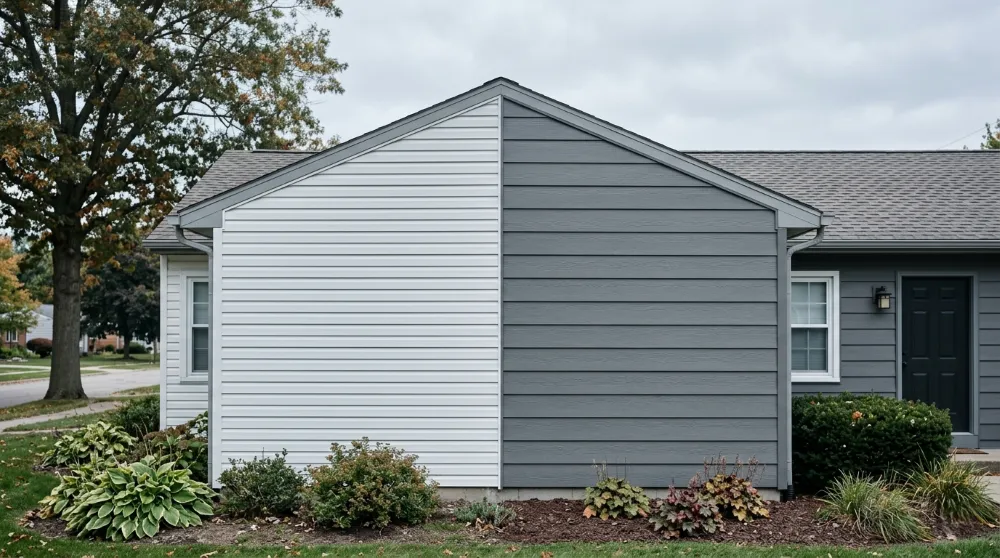
By the Calculate My Reno Team / Published
Skip to the tool
Open the Siding Calculator
Two materials dominate the siding aisle: vinyl (coloured-through PVC panels) and fibre cement (a dense cement-and-cellulose board, of which James Hardie is the best-known brand). Neither is simply “better” - they trade off cost and ease against toughness, fire resistance and looks.
At a glance
| Vinyl | Fibre cement (Hardie) | |
|---|---|---|
| Upfront cost | Lower | Higher |
| Installation | Light, DIY-friendly, clips on | Heavy, two-person, dust control |
| Maintenance | Wash occasionally, never paint | Wash; repaint finish ~15 yrs |
| Lifespan | ~20–40 yrs | ~30–50 yrs |
| Fire | Combustible - melts and burns | Non-combustible |
| Durability | Can crack in cold, dents | Resists impact, rot, termites |
| Look | Good, reads as plastic up close | Premium, paintable, crisp shadow lines |
| Resale | Neutral | Often adds value |
The real trade-off: cost and ease vs toughness
Vinyl wins on day one and on labour. It is the cheapest mainstream siding to buy, it is light enough for one person, it cuts with a knife and clips together, and because the colour runs all the way through it never needs painting. The downsides are that it can crack in hard cold, distort near heat, and up close it reads as plastic.
Fibre cement costs more to buy and more to install - the boards are heavy, it is a two-person job, and cutting it kicks up silica dust you have to control. In return you get a board that is non-combustible, resists impact, rot and termites, holds a crisp painted finish, and tends to lift resale value. It is the default in fire-prone and bushfire zones for that reason.
So the honest rule of thumb:
- Tight budget, rental, DIY, or a quick sale? Vinyl.
- Long-term home, fire-prone area, or a premium look you want to keep? Fibre cement.
Looks and finish
- Vinyl comes in many colours and profiles and looks fine from the street, but the seams and the plastic sheen show up close, and dark colours can fade.
- Fibre cement gives deep, crisp shadow lines and takes paint beautifully, so you can recolour it later. Factory-finished lines (like Hardie ColorPlus) save painting for years but cost more again.
Estimate either one the same way
Whichever you choose, the quantity comes from the same wall-area maths - total the walls, take off the openings, and convert to squares. Vinyl is then bought by the box (about 2 squares), while fibre-cement lap is bought by the board at its exposure. Use the siding calculator to size either, then compare the installed cost of each - not the per-piece price. Read how much siding do I need for the method and how to measure for siding before you order.
Frequently asked questions
Is fiber cement siding worth the extra cost?
Often, if you are staying put. Fibre-cement (such as James Hardie) costs more to buy and install than vinyl, but it is non-combustible, shrugs off impact, rot and termites, and tends to add more resale value. For a long-term home, a fire-prone area, or a look you want to keep premium, the extra is usually justified. For a rental, a tight budget, or a quick flip, vinyl is the value pick.
Does vinyl or fiber cement siding last longer?
Fibre cement generally lasts longer - commonly 30 to 50 years - because it does not melt, crack in the cold or fade as fast. Good vinyl lasts around 20 to 40 years. The catch is finish: factory-finished fibre cement holds its colour about 15 years before repainting, while vinyl is coloured all the way through and never needs paint.
Is fiber cement siding more fire resistant than vinyl?
Yes, clearly. Fibre cement is non-combustible and is used in fire-rated and bushfire/wildfire-zone construction. Vinyl is a plastic - it will soften, melt and burn, and can distort just from the radiant heat of a nearby barbecue or a neighbour's fire. In a fire-prone area that difference alone can decide it.
Is fiber cement siding harder to install than vinyl?
Yes. Fibre-cement boards are heavy, usually a two-person lift, and cutting them releases silica dust that must be controlled with the right blade and a mask. Vinyl is light, cuts with a knife and snips, and clips together - it is the more DIY-friendly of the two. Both are estimated the same way by wall area.