
Water Softener Cost
A whole-house water softener runs about $1,000 to $4,000 installed, and two things move that number: salt-based or salt-free, and whether your home already has a softener loop plumbed in. This guide prices both, sizes the salt-based one honestly, and shows where the installation bill actually hides.
By the Calculate My Reno Team / Published
Skip to the tool
Open the Home System Replacement Cost Calculator
Most homeowners pay somewhere between $1,000 and $4,000 to put a water softener in. The brand you choose matters less than two things you can settle before you call anyone.
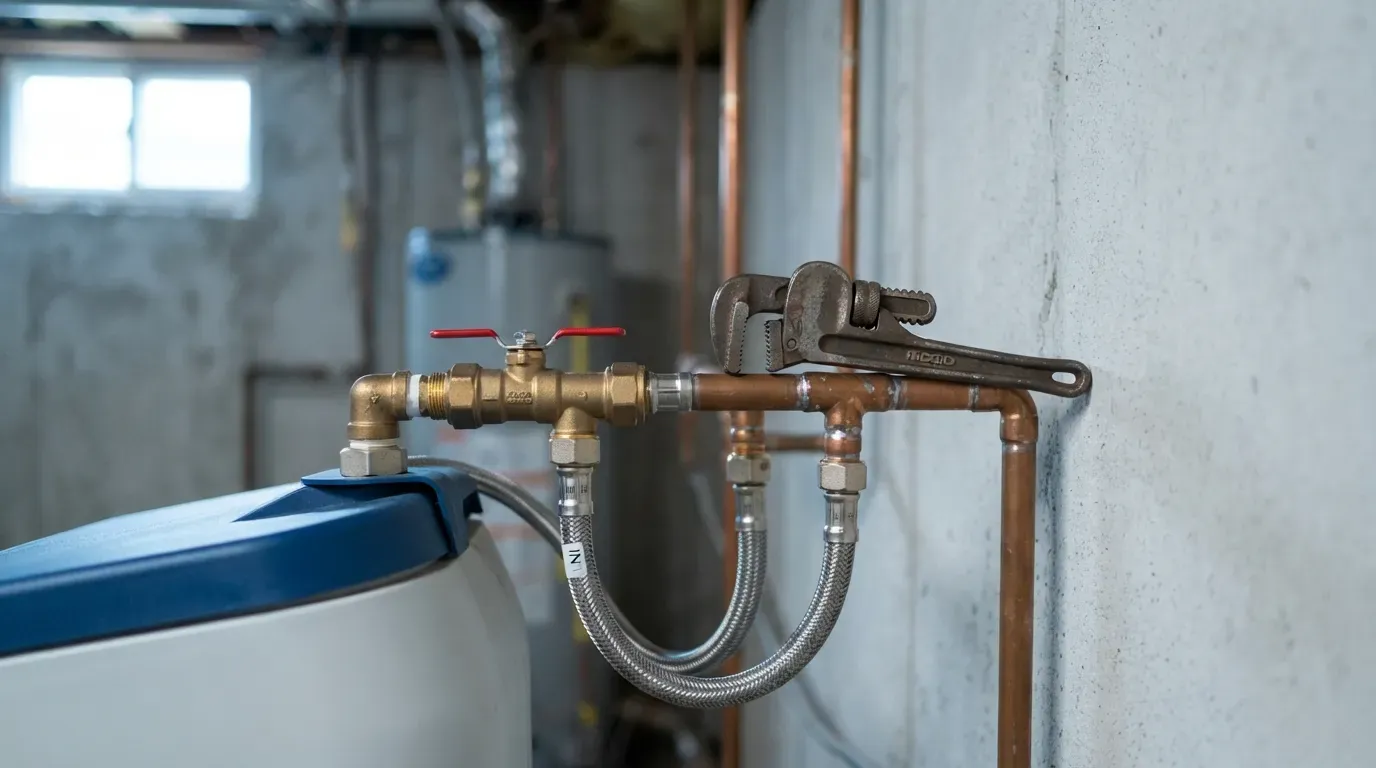
The first is the type - salt-based or salt-free. They are not the same machine, and the next section explains which does what. The second is whether your house already has a softener loop: a short pair of pipes stubbed out near where the water enters, waiting for a softener to connect to. If you have one, the install is cheap. If you do not, that is usually the biggest single line on the bill.
What a water softener costs, installed
A softener is sold as one price with the fitting included - the tank plus the plumber’s time. The cost guides quote it that way and do not neatly separate the two, so if a quote shows you a unit price and a separate labor charge on top, ask about it.
| What you are buying | Installed |
|---|---|
| Salt-based, 24,000 grain | $900 - $2,200 |
| Salt-based, 32,000 grain | $1,000 - $2,500 |
| Salt-based, 48,000 grain (the common size) | $1,200 - $3,000 |
| Salt-based, 64,000 grain | $1,400 - $3,300 |
| Salt-based, 80,000 grain | $1,600 - $3,600 |
| Salt-free conditioner (no grain rating) | $1,200 - $4,000 |
| Add a plumbing loop / drain | $200 - $800 |
| Sediment pre-filter · permit · haul-away | $60-300 · $100-500 · $75-300 |
These are indicative 2026 US contractor ranges from published cost guides (Angi, Quality Water Treatment, HomeGuide). They are a starting point, not a quote, and they shift with your water, your plumbing, and your installer.
Salt-based or salt-free: pick this first
These two get talked about as if they are the same thing. They are not.
A salt-based softener actually removes the hardness. Water runs through a bed of resin beads that trade the calcium and magnesium (the “hard” minerals) for a little sodium. Every so often the resin fills up and has to be rinsed clean with salty water - that rinse is called regeneration, and it is why a salt-based system has a second, shorter tank that you top up with bags of softener salt. Because the resin only holds so much before it needs rinsing, these units are rated in grains - how much hardness they can pull out before the next regeneration. This is what most people mean by “soft water”: slicker skin, soap that lathers, appliances that last longer.
A salt-free conditioner does not remove anything. It changes the minerals so they are less likely to stick and form scale, but they are still in the water. No salt, no salty rinse down the drain, and no grain rating, because nothing is getting used up.
So which is cheaper? Salt-based costs less to buy but adds roughly $100 a year in salt. Salt-free costs more up front and almost nothing to run. The real difference is the job they do. Want genuinely soft water for your skin, your soap, and your appliances? That is salt-based. Just want to keep scale off your pipes without dealing with salt? Salt-free will do it.
What size water softener do I need?
Size a salt-based unit to your household and your water. Do not buy the biggest tank in the store, and do not size it by the number of bathrooms.
The rule of thumb is simple arithmetic. Take the number of people in the house, multiply by about 75 gallons (roughly what one person uses in a day), then multiply by your water’s hardness in grains per gallon. That gives you the grains of hardness the softener has to remove every day. You want a unit large enough to run about a week between regenerations, so it is not rinsing itself every other day.
A family of four on typical hard water - about 10 grains per gallon - lands on a 32,000 to 48,000 grain unit. That is why 48,000 is the size most homes end up with. Do not guess the hardness: a cheap test strip settles it in a minute, and your water utility publishes the figure in its yearly report. It is the one number that decides the size. (Salt-free units skip all of this - they are matched to your water flow, not to grains - so “what size” is really only a salt-based question.)
Water softener installation cost
Fitting the unit is where the same job quietly varies by a thousand dollars, and the reason is almost always the plumbing loop.
- Your home already has a loop. (A pair of stubbed pipes near the water main - common in newer houses.) The labor is about $500 to $1,500, and a straight swap is often near the low end.
- Your home has no loop. Add $200 to $800 to plumb one in, plus a drain line for the rinse water and sometimes a nearby outlet. This is the line that makes one quote look far dearer than another.
- You fit it yourself, with a loop already there. Just the cost of the fittings. A softener is within reach for a confident DIYer when the pipes are already stubbed out. It stops being a weekend job once you are soldering a brand-new loop into the main line.
- Permit. Where one is needed, $100 to $500. It pays for an inspection of a fitting tied into your drinking water, which is worth having.
How the price adds up
water softener cost = the softener, installed (by type and grain size)
                    + a plumbing loop and drain   (only if you don't have one)
                    + a sediment pre-filter        (optional)
                    + the permit
                    + hauling the old unit away
Put your own numbers through the water softener cost calculator and you get a low, typical, and high band instead of one falsely exact figure. Then price the lines against a local quote.
What moves the total
- Salt-based or salt-free. The first fork, and the one that also sets your running cost for years.
- Whether you have a loop. Bigger than the gap between two tank sizes.
- Grain capacity. Real but small - a few hundred dollars from the smallest tank to the largest, not thousands.
- Where it goes. A softener next to the water main in an open basement is a quick afternoon. One that needs pipe run across a finished garage to reach a drain is not.
- Dealer or store. A dealer install buys you service and a warranty; a store-bought unit you fit yourself buys you the low end of the table. Both are fine - just price them against each other.
Worked example
A family of four with hard water (10 grains per gallon) and a softener loop already fitted.
- Salt-based, 48,000 grain, installed - $1,200 to $3,000. That is the size their water calls for, and it is the whole job.
- Add the permit ($100 to $500) and, if they want it, a sediment pre-filter ($60 to $300).
- Realistic total: about $1,360 to $3,800. With the loop already in place, they land nearer the low half.
Now the same house, but no loop:
- Same 48,000-grain unit, installed - $1,200 to $3,000.
- Plumb in the loop and drain: + $200 to $800. Neither is optional if you want the softener connected properly.
- Realistic total: about $1,560 to $4,600.
The softener did not change. The plumbing did. That gap is the whole installation decision, and it is why the calculator asks whether you are adding a loop.
Where water softener quotes go wrong
- Comparing salt-based and salt-free as if they do the same thing. One gives you soft water; the other only stops scale. Decide which you actually want before you compare prices.
- Buying more grains than you need. A giant tank that only regenerates every two weeks is not better - it is oversized and underused.
- A quote that leaves out the loop. On a house without one, that is the line that moves the total. A quote that skips it is not really an installed price.
- Reading a dealer rental as a purchase. A Culligan or Kinetico rental at $30 to $50 a month is a contract, not a price. Fine if you want the service - just weigh it against buying a unit outright first.
- Being charged twice for the fitting. These bands already include installation. A separate labor line on top of them needs explaining.
One last thing: if your water heater is about the same age as the softener you are replacing, price the two together. The same minerals that wear out a softener also scale up a tank. See water heater replacement cost.
Frequently asked questions
How much does a water softener cost?
Most homeowners pay about $1,000 to $4,000 to have one installed. Two things decide where you land. First, the type: a salt-based unit (the kind that removes hardness and refills with salt) is roughly $900 to $3,600 depending on size, with the common 48,000-grain unit around $1,200 to $3,000. A salt-free conditioner is about $1,200 to $4,000 and uses no salt. Second, your plumbing: if your house has no softener loop already fitted, adding one is $200 to $800 on top, and a permit another $100 to $500.
How much does water softener installation cost?
If you already own the unit, the labor to fit it is about $500 to $1,500 when your home has a softener loop near the water main, and a plain swap is often near the low end. With no loop - or where the plumber has to run a drain line and add an outlet - it costs more, which is why two "installation" quotes can be a thousand dollars apart. If you are handy and the loop is already there, you can do it yourself for the price of the fittings. Most quoted prices bundle the unit and the labor together, because that is how a softener is sold: installed.
Salt-based or salt-free - which is cheaper?
Salt-based is cheaper to buy; salt-free is cheaper to run. A salt-based softener is about $900 to $3,600 installed and then costs roughly $100 a year in salt. A salt-free conditioner is about $1,200 to $4,000 installed, uses no salt, and costs almost nothing to keep going. The catch is that they do different jobs: salt-based actually removes the hardness and gives you soft water, while salt-free only stops it from building up scale. If you want that slippery soft-water feel and easier soap, buy salt-based. If you just want to protect your pipes and appliances without salt, salt-free is fine.
What size water softener do I need?
Size a salt-based softener to your household and your water, not to the biggest tank in the store. Here is the rule of thumb: take the number of people in the house, multiply by about 75 gallons (what one person uses in a day), then multiply by your water hardness in grains per gallon. That is how many grains the softener has to remove each day, and you want one big enough to go about a week between refills. A family of four on typical hard water - around 10 grains per gallon - needs a 32,000 to 48,000 grain unit, which is why 48,000 is the size most people buy. Do not know your hardness? A cheap test strip or your water utility report will tell you.
How much does a Culligan water softener cost?
Culligan does not list a price, because local dealers sell and fit it and set their own. They often push a rental - roughly $30 to $50 a month - instead of a sale. If you buy one outright, expect it to sit at or above the top of the salt-based range, around $1,500 to $4,000 or more installed. What you get for the extra is local service and a longer warranty than a store-bought unit. The other dealer brands, Kinetico and EcoWater, work the same way. Ask for both the buy price and the rental terms in writing, and compare them against a unit you fit yourself.