
How to Winterize Sprinklers
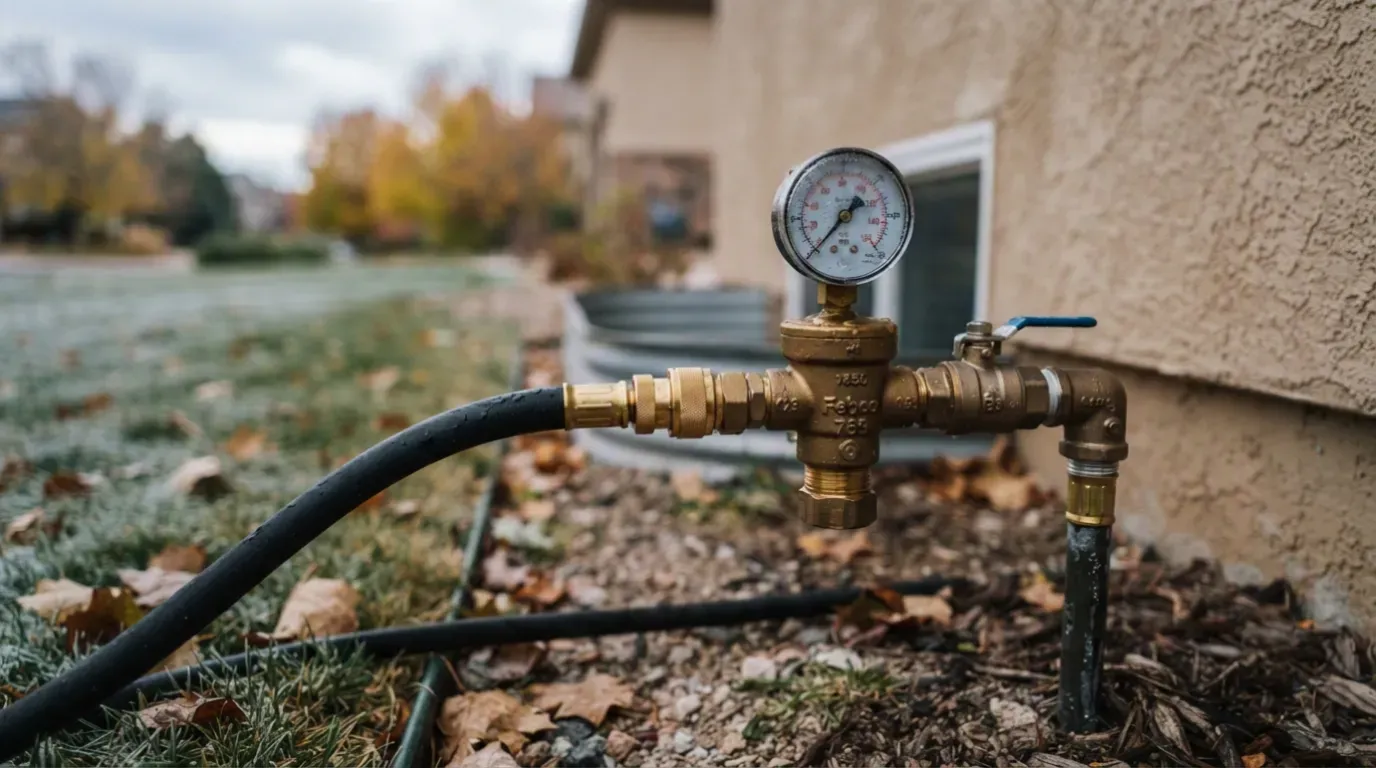
Freezing water splits pipe, cracks heads and wrecks the brass backflow assembly - the most expensive part of the system. Here is how to shut it down properly: drain it, blow it out zone by zone at a safe pressure, and put the controller to bed.
By the Calculate My Reno Team / Published
Skip to the tool
Open the Irrigation & Sprinkler Zone Calculator
Water expands by roughly 9% when it freezes, and it does it with enough force to split buried pipe, crack the bodies of pop-up heads and burst the brass backflow assembly - which is the single most expensive part of the system and the one part sitting above ground in the open. Winterizing is just the business of getting the water out before that happens.
Do it before the first hard freeze
Not during the first cold snap - a week or two before frost normally arrives where you live. Lateral lines are shallow, so one hard night can reach them, and the backflow preventer has nothing over it at all. There is no penalty for going early; the lawn barely needs water by then.
The four steps
- Shut the water off at the irrigation isolation valve - the one that feeds the system, not the house main.
- Put the controller in “off” or “rain mode” so it cannot open a valve in January. Modern controllers keep the schedule in memory; you do not need to pull the plug and lose your programs.
- Get the water out of the lines - by drain valve or by blow-out, depending on how the system was built.
- Protect the backflow preventer - drain it, leave its test cocks part open, and insulate it.
Which draining method is yours?
| Method | How it works | When it is enough |
|---|---|---|
| Manual drain | Drain valves at the low points; you open them and gravity does the rest | Ground genuinely falls to the drains |
| Automatic drain | Valves that open themselves once line pressure drops below about 10 psi | Same - relieve pressure by running a zone briefly |
| Blow-out | Compressed air pushes the water out through the heads | Flat yards, uphill runs, any pipe with a belly in it |
If you do not know how yours was built, treat it as needing a blow-out. A flat yard does not drain by gravity no matter how long the valves stay open, and it only takes one low spot holding water to split a line.
The blow-out, done safely
This is the step people get wrong, and the mistake is always the same: reaching for pressure because the compressor has no volume.
Pressure does not clear the line. Air volume does. A house system wants roughly 20 to 50 CFM, which means a towable or a large shop compressor. A pancake compressor puts out 2 to 5 CFM - the tank empties in seconds and the water hardly moves.
And there is a hard ceiling on the pressure whatever compressor you have:
| Pipe | Maximum blow-out pressure |
|---|---|
| Rigid PVC | 80 psi |
| Flexible polyethylene | 50 psi |
Stay under whatever your heads and valves are rated for, too. Turning the regulator up to 120 psi to compensate for missing CFM is how fittings crack and head seals blow out - you will spend the spring replacing exactly the parts you were trying to protect.
The sequence:
- Connect at the blow-out port downstream of the backflow preventer, and close the backflow isolation valves. Never force air through the backflow assembly.
- Shut off the water supply.
- Open one zone at the controller before you introduce air - the air needs somewhere to go.
- Bring the pressure up slowly, to the limit in the table above and no further.
- Work one zone at a time, starting with the zone farthest from the compressor.
- Run each zone only until the heads stop throwing water and drop to a mist - usually well under two minutes. Then move on. Dry air spinning a gear-drive rotor heats it, and a head run dry for long enough will cook its own gears and seals.
- Go round a second time rather than blasting any one zone for longer. Two short passes clear a line better and far more safely than one long one.
Wear eye protection and stay off the heads: they pop up hard under air and they spit grit.
The sprinkler zone calculator lists the zones your system needs and the head type on each - useful here, because it tells you how many zones you have to work through and which ones are rotors that need the two-minute rule taken seriously.
The backflow preventer
The part most likely to be destroyed, and the one no amount of blowing out protects on its own:
- Close both isolation valves on the assembly.
- Open the test cocks part way - roughly 45 degrees - so any water still trapped in the body can escape and expanding ice has somewhere to go.
- Insulate it. An insulated pouch or bag is the usual answer. Do not seal it in something airtight and water-holding; the point is to keep frost off it, not to trap moisture against the brass.
If your assembly sits inside a heated space, all it needs is the water shut off.
In spring, reverse it slowly
Open the isolation valve slowly when the system goes back into service. Snapping a valve open against an empty system sends a slug of water down a dry line at full pressure - water hammer - and it breaks pipe that survived the entire winter. Fill it gently, then run each zone and check for heads that did not survive.
Where the money actually goes
Winterizing is a chore and it is nearly free. The bill arrives when it is skipped: a split lateral is a dig, a cracked backflow assembly is a plumber, and neither is a job you were planning to spend money on. If you are pricing a system rather than putting one to bed, see how much a sprinkler system costs.
Frequently asked questions
How do I winterize my sprinkler system?
Four steps, in order. Shut off the water at the irrigation isolation valve (not the house main). Turn the controller to "off" or "rain mode" so it cannot open a valve mid-winter. Get the water out of the pipe - by opening the manual drain valves, by letting the automatic drains do it, or by blowing the lines out with compressed air, whichever your system was built for. Then protect the backflow preventer: drain it, open its test cocks part way, and insulate it. The blow-out is the step most systems need, because flat ground does not drain by gravity.
How do I blow out my sprinklers?
Connect the compressor downstream of the backflow preventer, at the blow-out port, and close the backflow isolation valves so no air is forced through the assembly. Shut off the water. Open one zone at the controller so the air has somewhere to go, then bring the pressure up slowly - never above 80 psi on rigid PVC or 50 psi on flexible poly pipe. Work one zone at a time, farthest from the compressor first. Run each zone only until the heads stop throwing water and go to a mist, which is usually well under two minutes, then move on. Two short passes clear a zone better and far more safely than one long blast.
What PSI should I use to blow out sprinklers?
Cap it at 80 psi for rigid PVC lines and 50 psi for flexible polyethylene pipe, and stay under whatever your own heads and valves are rated for. Pressure is not what clears the line, though - air volume is. A blow-out wants roughly 20 to 50 CFM, which is a towable or large shop compressor. Turning a small compressor up to 120 psi to make up for the CFM it does not have is how people crack fittings and blow the seals out of their heads.
Can I blow out sprinklers with a small air compressor?
Usually not properly. A pancake or hotdog compressor puts out something like 2 to 5 CFM, and a sprinkler zone needs 20 to 50 CFM to push a column of water out of a few hundred feet of pipe. The tank empties in seconds, the water barely moves, and the temptation is to crank the pressure - which is the one thing you must not do. If your system has manual drain valves at the low points, drain it instead. Otherwise this is the job to hire out or borrow a real compressor for.
When should I winterize my sprinklers?
Before the first hard freeze, not during it - so a week or two ahead of the date frost usually arrives where you live. The lateral lines and heads sit shallow, so a single cold night can reach them, and the backflow preventer is above ground with nothing protecting it at all. There is no cost to doing it early: the lawn needs very little water by then anyway.
Do I have to blow out my sprinkler system?
Only if the water cannot get out on its own. Systems built with manual or automatic drain valves at the low points, on ground that actually falls toward them, will drain by gravity. Flat yards, uphill runs and any pipe with a belly in it will hold water no matter how long you leave the valves open, and that trapped water is what splits the pipe. If you do not know how yours was built, treat it as needing a blow-out. In a climate that never gets a hard freeze, insulating the backflow preventer and the above-ground valves may be all that is required.