
How Much Gravel Do I Need for a Retaining Wall?
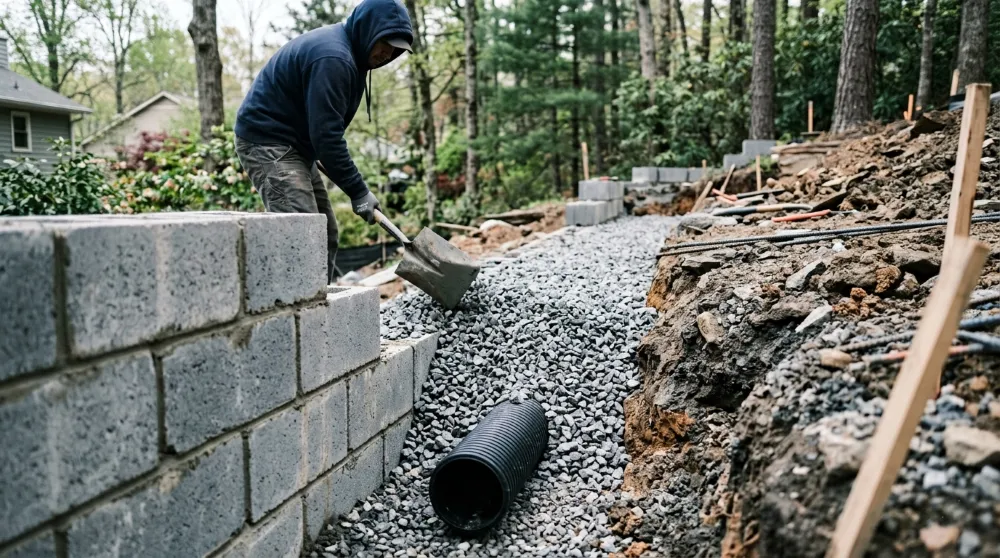
A retaining wall needs gravel in two places: a compacted pad under the first course, and a free-draining zone behind the blocks. Here is how to size both, so the wall sits level and water never builds up behind it.
By the Calculate My Reno Team / Published
Skip to the tool
Open the Retaining Wall Calculator
A retaining wall needs gravel in two distinct places, and they do different jobs: a compacted base that the wall sits level on, and a free-draining backfill behind the blocks that keeps water off the wall. Size them separately.
The two gravel layers
base gravel     = wall length × (block depth + ~150 mm) × pad depth
backfill gravel = wall length × wall height × backfill thickness
The retaining wall calculator gives both volumes directly - the base leveling pad and the drainage backfill - once you set the backfill zone thickness (about 300 mm / 12 in is common). They are two different materials, so order them as two lines.
| Layer | Where | Typical depth / thickness |
|---|---|---|
| Base leveling pad | Under the first course | 100-150 mm (4-6 in) deep |
| Drainage backfill | Behind the blocks | ~300 mm (12 in) wide zone |
| Drain pipe | Base of the backfill | Perforated, to a slight fall |
Base leveling pad
The pad is a compacted granular base in a trench a little wider than the block, so the wall has a flat, solid footing. Run it the full wall length, and a touch wider than the block depth so the front and back edges are supported. Compact it in layers and screed it dead level - every course above copies the first one, so a high or low spot here shows all the way up.
Drainage backfill
Behind the blocks goes a zone of clean, free-draining gravel - not the compactible base material, which would trap water. Water that gets into the slope falls through this gravel to a perforated drain pipe at the bottom, which carries it out to daylight. This is what stops water pressure building up behind the wall, the single most common cause of a block wall bulging or failing.
Worked example
A 6 m long, 0.9 m high wall in 300 × 150 mm blocks (200 mm deep), with a 150 mm pad and a 300 mm backfill zone:
- Base gravel: 6 × (0.20 + 0.15) × 0.15 = 6 × 0.35 × 0.15 = 0.32 m³.
- Backfill gravel: 6 × 0.9 × 0.30 = 1.6 m³ of free-draining stone.
- Drain pipe: 6 m along the base, plus the run out to daylight.
In imperial, a 20 ft × 3 ft wall comes out near 0.43 yd³ of base and about 2.2 yd³ of backfill.
A few tips
- Order base and backfill as two different materials - compactible base under, clean drainage stone behind. They are not interchangeable.
- Gravel is heavy: roughly 1.5 tonnes per cubic metre, so a couple of cubic metres is a real delivery. Order a little extra, as the base compacts down.
- Lay the drain pipe first, on a slight fall, before you backfill - retrofitting it means digging the gravel back out.
- Get the block count and the full cost at the same time so you order the whole job in one go.
Frequently asked questions
How much gravel do I need for a retaining wall?
Two lots. The base leveling pad is the wall length times a trench a little wider than the block (block depth plus about 150 mm) times 100-150 mm deep. The drainage backfill is the wall length times the height times the gravel zone behind the blocks (about 300 mm / 12 in). A 6 m × 0.9 m wall needs roughly 0.3 m³ of base gravel and about 1.6 m³ of drainage backfill.
What kind of gravel goes under and behind a retaining wall?
The base pad is a compacted granular base - crushed stone or road base that locks together when tamped. The backfill behind the wall is a clean, free-draining angular gravel (often called drainage stone or clear stone), which lets water fall to the drain pipe instead of pushing on the wall. Do not use the same fine, compactible base material as the backfill - it holds water.
How deep should the gravel base be under a retaining wall?
A compacted leveling pad of about 100-150 mm (4-6 in) is typical for a low wall, on firm subgrade. Taller or engineered walls may call for a deeper or wider base in the design. Compact it in layers and screed it dead level - the whole wall is only as straight as its first course.
Do I need a drainage pipe behind a retaining wall?
For most walls, yes. A perforated pipe at the base of the gravel backfill, laid to a slight fall and run out to daylight, carries away the water the gravel collects. Without it, water pressure (hydrostatic load) builds behind the wall and is a leading cause of bulging and failure. Wrap the pipe and gravel in a filter fabric if the soil is silty.