
Sprinkler Head Types
Rotor, spray, rotary nozzle and drip are the main sprinkler head types, and each waters at a very different rate - which is why the types go on separate zones. Here is how to choose the right head for each area.
By the Calculate My Reno Team / Published
Skip to the tool
Open the Sprinkler & Irrigation Zone Calculator
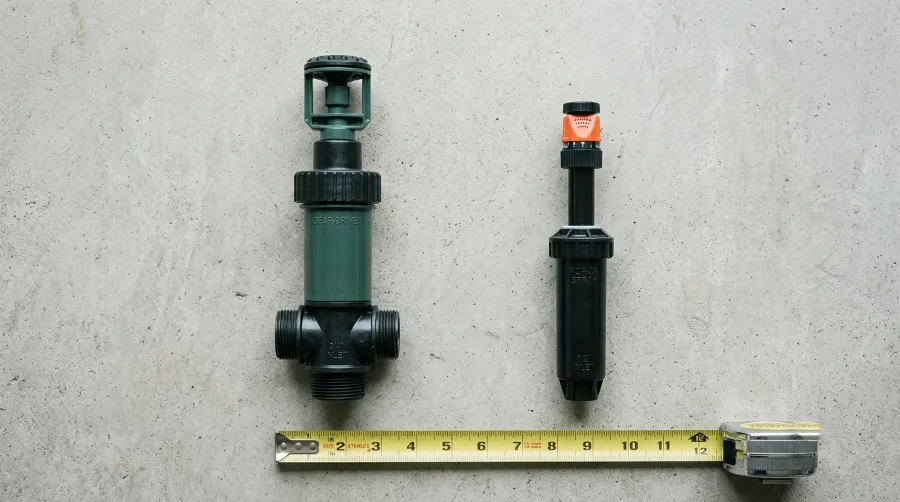
Rotors and sprays are the two workhorse lawn sprinkler heads. The right choice comes down to the size of the area and, just as important, keeping the two apart on your zones.
Side by side
| Rotor (gear-drive) | Fixed spray | |
|---|---|---|
| How it waters | A stream that rotates back and forth | A fixed fan |
| Throw distance | ≈ 18-45 ft | ≈ 8-15 ft |
| Flow per head | 1.5-5 GPM | 1-3.5 GPM |
| Precipitation rate | 0.4-0.6 in/hr (slow) | 1.3-1.8 in/hr (fast) |
| Best for | Large open lawn | Small, narrow or tight areas |
| Heads needed | Fewer (long throw) | More (short throw) |
Why they never share a zone
The key number is the precipitation rate - how fast each lays water down. A rotor applies water roughly three times slower than a spray. Put both on one valve and any run time is wrong for one of them: long enough for the rotors floods the sprays, short enough for the sprays leaves the rotors’ grass dry. So rotors go on rotor zones and sprays on spray zones, each with its own run time. The sprinkler zone calculator groups head types automatically and gives each its own run time.
When to use each
- Rotors - large open lawns and wide parkways. The long throw means fewer heads, less misting lost to wind, and lower flow per square foot.
- Sprays - narrow strips, small lawns, and tight corners a rotor would overshoot onto the drive or fence.
- Rotary nozzles - a spray-body fitting that streams like a mini rotor; a useful middle ground at a low precipitation rate, and they can match rotors better than fixed sprays can.
- Drip - beds, borders and around shrubs, where any sprinkler head wastes water on foliage and paths. Drip emitters water the roots directly and go on their own zone, never shared with rotors or sprays. See drip vs sprinklers.
Matched precipitation
Within a spray zone, use nozzles with matched precipitation rates so a quarter-circle and a full-circle head put down the same depth - otherwise some patches get four times the water. Rotors are chosen the same way. Either way, keep one head family per zone.
Putting it together
Pick the head type for each area by its size and shape, then size the zones in the irrigation calculator - it counts the heads, keeps rotors and sprays on separate zones, and gives each its run time. For beds and borders, drip beats both.
Frequently asked questions
What is the difference between rotor and spray sprinkler heads?
A rotor streams water back and forth over a long distance (about 18-45 ft) and applies it slowly, around 0.4-0.6 in/hr - good for open lawn. A fixed spray throws a fan over a short distance (about 8-15 ft) and applies it fast, around 1.3-1.8 in/hr - good for tight or narrow areas. Because they apply water at such different rates, they need different run times and never share a zone.
Can I mix rotor and spray heads on the same zone?
No. Rotors apply water about three times slower than sprays, so any run time that suits one badly over- or under-waters the other - dry patches under the rotors or puddling under the sprays. Keep each head type on its own zone with its own run time. The sprinkler zone calculator groups them separately for this reason.
Which is better, rotors or sprays?
Neither is better overall - they suit different areas. Use rotors for large open lawns, where their long throw means fewer heads and less water lost to the air. Use sprays for small, narrow or oddly shaped areas a rotor would overshoot. Most yards use both, on separate zones.