
Drip Irrigation vs Sprinklers
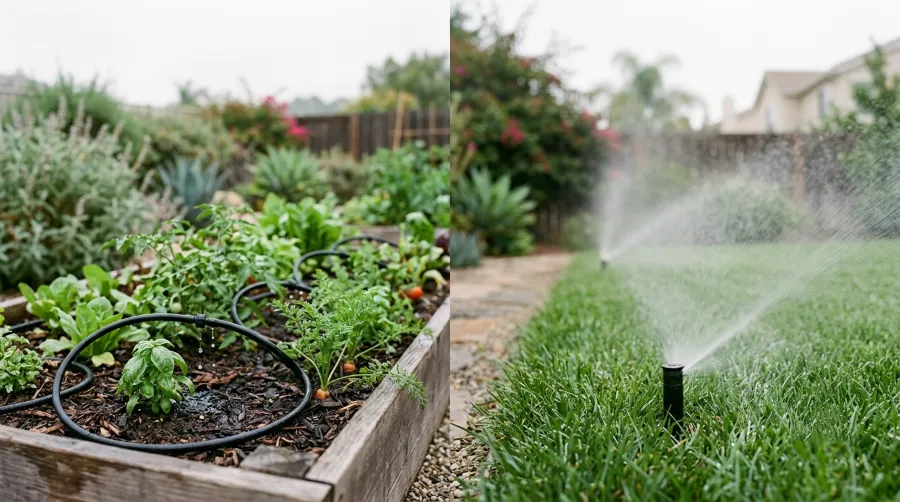
Drip and sprinklers solve different problems: sprinklers cover open lawn, drip waters beds and rows efficiently - and a soaker hose is the simple middle option. Here is how they compare and why most yards use both, on separate zones.
By the Calculate My Reno Team / Published
Skip to the tool
Open the Sprinkler & Irrigation Zone Calculator
Drip and sprinklers are not rivals so much as tools for different jobs. Knowing which suits each part of the yard - and keeping them on separate zones - is what makes a system efficient.
Side by side
| Drip irrigation | Sprinklers | |
|---|---|---|
| Best for | Beds, borders, hedges, rows, pots | Open lawn and large turf |
| How it applies water | Slowly, at the root zone | Sprayed over the surface |
| Water efficiency | High (little evaporation/runoff) | Lower (drift, evaporation) |
| Flow per outlet | 0.5-2 GPH per emitter | 1-5 GPM per head |
| Pressure | Low (25-30 psi) | Higher (30-45 psi) |
| Coverage | Only where emitters sit | Broad, even circles |
Why they go on separate zones
Drip emitters draw a tiny fraction of a sprinkler head’s flow and run at a much lower pressure. Put both on one valve and you cannot satisfy both: enough pressure for the sprinklers blows the drip fittings, and enough run time for the drip floods the lawn. So drip always gets its own zones, its own pressure regulator and filter, and its own run time. The sprinkler zone calculator groups head types automatically for this reason.
When to use each
- Lawn - sprinklers (rotors for open areas, sprays for tight ones). See rotor vs spray heads.
- Beds, borders, hedges - drip line or emitters, one per plant or a run along the row.
- Vegetable rows and raised beds - drip line, spaced to the crop.
- Pots and planters - micro-drip with individual emitters.
Soaker hose vs drip
A soaker hose is the low-effort cousin of drip: a porous hose that weeps water along its whole length instead of releasing it at fixed emitters. Both water beds at the root zone and both run at low pressure, so the choice comes down to precision and lifespan.
- Soaker hose - cheapest and simplest to lay along a straight bed or row, and it wets everything it touches, so it suits densely planted beds. But it applies less evenly over long runs (more at the start than the end, worse on a slope), and porous hose clogs and degrades in sun faster than drip tubing. Keep runs short (roughly 50-100 ft) and add a pressure reducer.
- Drip - emitters put a measured amount exactly where each plant sits, stay even over much longer runs, and last longer, at the cost of more parts and setup. Better for spaced plants, long rows, containers and anything you want to water precisely.
For a small straight bed a soaker hose is often enough; for spaced plants, slopes or a system you will keep for years, drip is the better tool. Either way it runs on its own low-pressure zone, never with the lawn sprinklers.
Cost
Per zone, drip is usually cheaper than a sprinkler zone - the parts are lighter and there is less trenching. Across a whole system the totals depend on how much lawn vs bed you have. See how much a sprinkler system costs for the per-zone figures.
The takeaway
Use sprinklers for lawn, drip for everything planted, and keep them on separate zones. Size it all - sprinkler zones and drip zones together - in the irrigation calculator, then set each zone’s run time to suit how fast it applies water.
Frequently asked questions
Is drip irrigation better than sprinklers?
For beds, borders, hedges, pots and vegetable rows, drip is better - it delivers water straight to the roots with very little lost to evaporation or overspray, often using 30-50% less water than sprinklers. For open lawn, sprinklers are better, because drip cannot cover a broad turf area evenly. Most yards use both, each on its own zones.
Can I put drip and sprinklers on the same zone?
No. Drip applies water far more slowly than a sprinkler and needs a much lower pressure (often 25-30 psi vs 30-45 psi), so sharing a valve would either flood the sprinklers or starve the drip. Always run drip on its own zones with its own pressure regulator and run time.
Does drip irrigation save water?
Yes, usually 30-50% over spray for the same plants, because it puts water at the root zone with almost no evaporation, wind drift or runoff. It also keeps foliage dry, which reduces disease, and waters only where the emitters are rather than the whole bed.
Soaker hose vs drip irrigation - which is better?
A soaker hose is cheaper and simpler and suits a short, densely planted straight bed, but it waters less evenly over long runs and on slopes and wears out faster. Drip uses emitters to place a measured amount at each plant, stays even over much longer runs, and lasts longer, so it is better for spaced plants, rows, slopes and containers. Both water at the root zone at low pressure and both belong on their own zone, separate from lawn sprinklers.