
How to Lower pH in a Pool
You lower pool pH with an acid - muriatic acid or dry acid - dosed against the volume of water. But if it climbs straight back within a few days, the acid is not the problem: your total alkalinity is.
By the Calculate My Reno Team / Published
Skip to the tool
Open the Pool Volume Calculator
pH is the one pool reading that will not sit still, and it moves in one direction: up. Here is how to bring it down, and - more usefully - why it keeps coming back.
The short version
pH too high  →  add acid (muriatic acid or dry acid)
pH too low   →  add soda ash
Both are dosed per 10,000 gallons, so the first thing you need is not a chemical, it is a number. Get it from the pool volume calculator - it takes the shape, the size and the average depth and returns the volume in US gallons, so the dose on the label actually means something.
The target band
| Reading | Target | What happens outside it |
|---|---|---|
| pH | 7.2 - 7.8 (aim 7.4 - 7.6) | Low: corrosive water, etched plaster, stripped grout. High: weak chlorine, scale, cloudy water |
| Total alkalinity | 80 - 120 ppm | Low: pH bounces everywhere. High: pH climbs and will not stay down |
| Free chlorine | 1 - 4 ppm | Below 1 ppm the water is not being sanitized |
pH and alkalinity are not two independent dials. Total alkalinity is the water’s buffer - its resistance to pH change - which is exactly why the pH reading is the symptom and the alkalinity reading is usually the cause.
Lowering pH, step by step
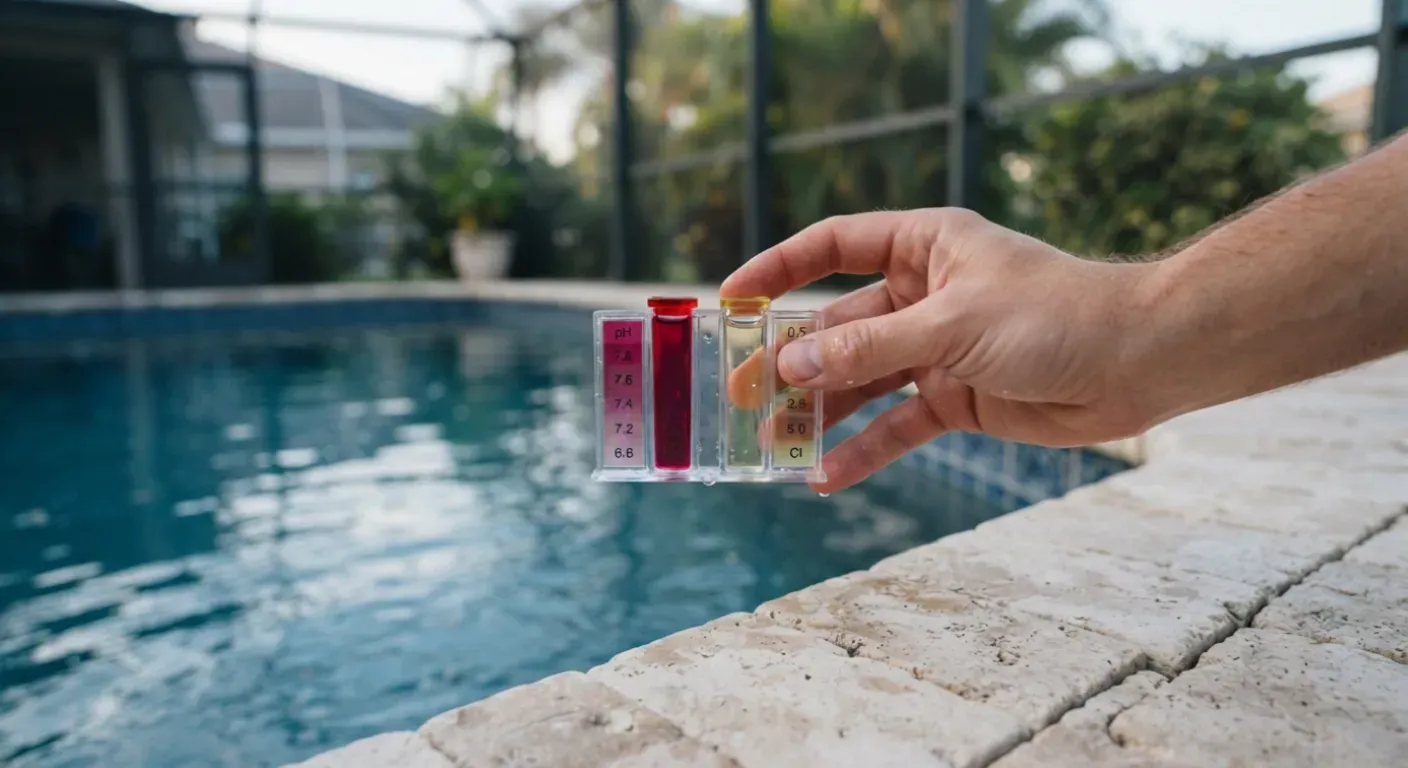
- Test first, and test properly. A strip is fine for a rough check; a drop kit or a mail-in sample is worth it when a reading will not behave. Read pH and total alkalinity, because you are about to move both.
- Get your volume. Dose per 10,000 gallons is meaningless without it.
- Pick your acid. Muriatic acid is liquid, cheap and fast, and it is roughly 31% hydrochloric acid, so it needs respect and ventilation. Dry acid (sodium bisulfate) is a granular powder, easier and safer to handle, and slightly kinder to a pool that is already carrying a lot of sulfates.
- Deliberately under-dose. Calculate the full amount, then add about half to three quarters of it. You can always add more; pulling pH back up costs you another chemical and another day.
- Dilute and distribute. Add the acid to a bucket of water - never water into acid - and pour it slowly around the deep end with the pump running. Do not pour it into the skimmer.
- Wait, then retest. Give it at least six hours of circulation. Retesting after twenty minutes tells you about one corner of the pool, not the pool.
⚠️ Never mix acid with any chlorine product, in a bucket, in a container or on the pool deck. That combination releases chlorine gas. One chemical at a time, one bucket at a time, and rinse between.
Why it climbs back: the alkalinity trap
This is the part most pH pages skip, and it is the reason people end up buying acid by the case.
Acid lowers both pH and total alkalinity. So if your alkalinity is sitting at 180 ppm, every dose you add is being spent mostly on the buffer, and the pH springs back within days. You are treating the reading rather than the water.
The sequence that actually works:
- Bring total alkalinity into the 80 - 120 ppm band first, with acid. Accept that pH will dip below target while you do it.
- Then let pH come back up on its own, or speed it along with aeration - a fountain, a return jet aimed up at the surface, the pool cleaner throwing water about. Aeration drives dissolved carbon dioxide out of the water, which raises pH without raising alkalinity.
- Repeat until alkalinity holds in band. Now the pH will stay where you put it.
That aeration step is the useful trick in pool chemistry: it is the only common lever that moves pH in one direction while leaving alkalinity alone.
The other reasons pH rises
- A salt chlorine generator. The cell produces sodium hydroxide as a by-product of making chlorine, so a salt pool trends alkaline more or less permanently. This is normal, not a fault. Expect to add acid on a schedule rather than as a fix.
- New plaster or gunite. A fresh surface leaches calcium hydroxide as it cures and will push pH up hard for the first several months. Test far more often than usual during that window.
- Water features. A waterfall, a spillover spa or a deck jet is aeration by another name, and it lifts pH every hour it runs.
- Fill water. If your tap water is hard and alkaline, every top-up after evaporation is a small dose of the problem. Test the hose water once so you know what you are refilling with.
Worked example
A 16 by 32 ft pool sloping from 3 ft to 7 ft, reading pH 8.0 and total alkalinity 170 ppm:
surface area  = 16 × 32       = 512 sq ft
average depth = (3 + 7) ÷ 2   = 5 ft
volume        = 512 × 5 × 7.48 ≈ 19,150 US gallons
So it is a ~19,000 gallon pool, and every dose on every label needs multiplying by 1.9. But note what the numbers say: alkalinity is 50 ppm above the top of the band. Chasing the 8.0 on its own would mean adding acid this week, next week and the week after. The job here is the alkalinity, and the pH will follow it down and then settle.
Where people go wrong
- Reaching for baking soda. It raises alkalinity. It is the fix for the opposite problem, and it is the single most common mistake at the pool store shelf.
- Dosing off a guess at the volume. A “20,000 gallon pool” that is really 13,000 gets over-dosed by half on every chemical it ever receives.
- Retesting too soon. You measure the plume, not the pool, and then add more.
- Fixing pH while ignoring alkalinity. The reason you are back here next Saturday.
- Adding acid and chlorine on the same trip. Space them out, and never combine them in a bucket.
Once the water is holding its band, the rest of the routine is short - see pool maintenance for the weekly and seasonal schedule, and pool chemicals for what each bottle in the shed is actually for.
Frequently asked questions
How do I lower the pH in my pool?
Add an acid - either muriatic acid (liquid) or dry acid, which is sodium bisulfate. Both are dosed per 10,000 gallons, so you need your pool volume before you open the bottle. Dilute the dose in a bucket of water, pour it slowly around the deep end with the pump running, then wait at least six hours and retest before adding any more. Never add acid to a bucket that already has any chlorine product in it.
Why does my pool pH keep going up?
Almost always because total alkalinity is high. Alkalinity is the water's resistance to pH change, so a pool sitting at 150 or 200 ppm will drag pH back up every time you knock it down. Other common causes: a salt chlorine generator (the cell produces a by-product that raises pH), a new plaster or gunite surface curing over its first several months, and any water feature or aggressive aeration, which drives carbon dioxide off and lifts pH without changing anything else.
How much muriatic acid do I need to lower pH?
It depends on the pool volume, how far the pH has to come down, and how high the alkalinity is - a high-alkalinity pool needs noticeably more acid to move the same distance. Work out your volume first, follow the dose per 10,000 gallons on the label, and deliberately add less than the full calculated amount. Retest after six hours and repeat if needed. Overshooting into acidic water is far more damaging than an extra day at a high reading.
Does baking soda lower pH in a pool?
No - it does the opposite. Baking soda (sodium bicarbonate) raises total alkalinity and nudges pH up slightly. It is the fix for low alkalinity, not high pH. The two get confused constantly because both readings live on the same test strip. If your pH is high, you want acid.
What should pool pH be?
Between 7.2 and 7.8, and most guidance narrows that to 7.4 to 7.6. Below 7.2 the water turns corrosive and starts attacking plaster, grout and metal parts; above 7.8 chlorine loses most of its punch and you get scale and cloudy water. The band matters more than the exact number.
Can I swim after lowering the pH?
Wait until the acid has circulated fully and you have retested - a few hours with the pump running is typical, and check the product label, which will give its own figure. The reason is not the pH itself but the possibility of an undiluted pocket of acid sitting near where you poured it. Running the pump and retesting settles both questions at once.