
Postcrete: Bags Per Fence Post, Setting Time and How to Use It
Postcrete is the fast-setting post mix almost every British fence gets built with, and it is used nothing like ordinary concrete - it goes into the hole dry. Here is how many bags a post takes, how to work it out for your hole, and how to use it without wasting any.
By the Calculate My Reno Team / Published
Skip to the tool
Open the Fence Calculator
Postcrete is the bagged fast-setting post mix that most British fences get built with. The name is a brand - Blue Circle Postcrete, made by Tarmac - and like Hoover and Biro it has drifted into being the word for the whole product category, so merchants and tradespeople will use it for any bagged post-fixing mix.
It is worth knowing what it actually is, because it behaves nothing like the concrete next to it on the pallet: it goes into the hole dry, it sets in minutes, and the number of bags a post swallows is decided by something most people never measure.
The thing that decides your bag count
Not the depth. The width of the hole.
A post hole is a cylinder, and the volume of a cylinder goes up with the square of its diameter. Dig a hole half as wide again and you have not bought yourself half as much concrete again - you have bought nearly three times as much. Depth, by contrast, is linear: twice as deep is exactly twice the concrete.
Here is what that looks like for a standard 100 mm timber post at 600 mm deep, with the volume the post itself takes up already subtracted:
| Hole diameter | Concrete needed | 20 kg bags |
|---|---|---|
| 200 mm | about 13 litres | 2 |
| 250 mm | about 23 litres | 3 |
| 300 mm | about 36 litres | 4 |
The often-repeated “one or two bags a post” is not wrong, but it describes a narrow hole - the sort an auger or a post-hole spade leaves. The moment you are digging 300 mm across, which people routinely do when the ground is stony or the spade will not go in cleanly, the same post takes four.
So measure the first hole you dig before you buy for the whole run. On a twenty-post fence, guessing two when the answer is four is forty bags short.
Working it out for your own hole
hole volume  = π × (hole diameter ÷ 2)² × depth
post volume  = post width × post width × depth
concrete     = hole volume - post volume
bags         = ceil( concrete ÷ bag yield )
A 20 kg bag makes roughly 9 to 10 litres of set concrete. That is an approximation - check the yield printed on your own bags, since it varies a little between brands - but it is close enough to buy from, and rounding up is the right direction to be wrong in.
Two adjustments worth making before you order:
- A hand-dug hole is not a neat cylinder. It comes out squarer and wider at the top than you intended. Add a bag.
- A gravel or hardcore base of 100 mm to 150 mm at the bottom of the hole helps the post drain, and it takes that much off the concrete. If you are using one, work the volume off the remaining depth.
The calculator above does the post count for the whole fence and multiplies it by your bags per post, so once you have settled on a figure for one hole you get the number for the pallet.
How much post to bury
The standard is to put about a third of the above-ground height into the ground, with roughly 600 mm as the floor for a garden fence. So:
| Fence height | Buried | Post length to buy |
|---|---|---|
| 1.2 m | 600 mm | 1.8 m |
| 1.5 m | 600 mm | 2.1 m |
| 1.8 m | 600 mm | 2.4 m |
That is why 2.4 m posts and 1.8 m panels are the pairing you see stacked outside every builders’ merchant in the country. For component sizes and post spacings to spec, BS 1722 is the British Standard that covers fences.
Gate posts, corner posts and end posts are the exception. They carry loads the line posts never see, so give them more depth, a wider hole and a heavier section.
How to actually use it
This is the part that catches people who have used ordinary concrete. You do not mix Postcrete. There is no barrow, no mixer and no shovelling it about.
- Dig the hole and put in the gravel base if you are using one.
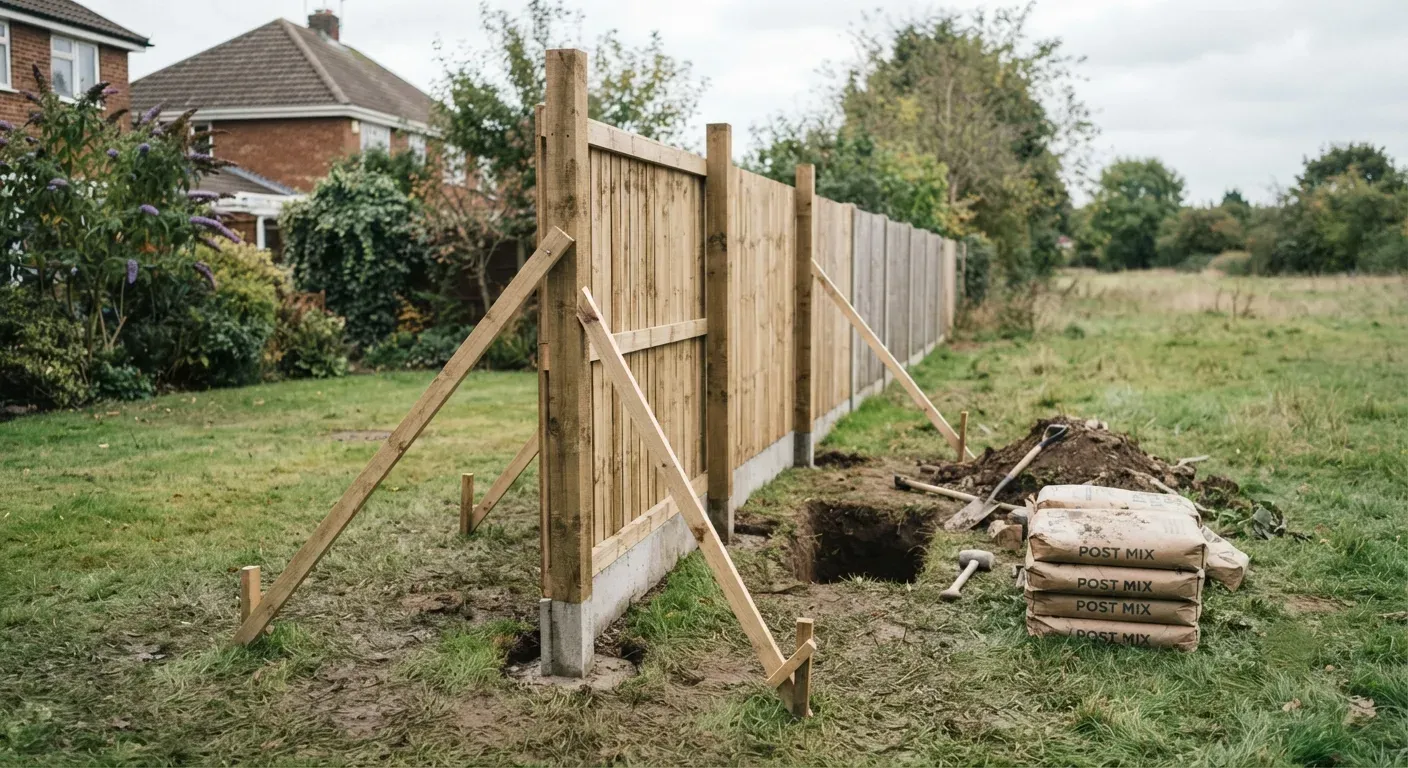
- Stand the post in and brace it. Two timber battens screwed to the post and pegged to the ground will hold it. Get it plumb on a level in both directions now, and get the height right against your string line - once the mix is in, the argument is over.
- Pour water into the hole, roughly a third to half full. Yes, water first.
- Tip the dry mix in around the post, straight from the bag, distributing it evenly around all four faces rather than dumping it down one side.
- Top up with a little more water if the mix looks dry on top, and give it a poke with a batten to release trapped air.
- Leave it alone. It goes off in around ten minutes - check your own bag, and expect it to be quicker on a warm day.
- Finish the top above ground level and slope it away from the timber so rain runs off rather than sitting against the post. Water standing on a flat concrete collar is what rots a post at ground level.
Work one post at a time. The fast set is a gift when you are on your own and a trap if you have four holes open and are trying to be clever.
Common mistakes
- Mixing it in a barrow first. It sets in the barrow. This is the one everybody has done once.
- Plumbing the post after the pour. Ten minutes is not the leisurely window it sounds like, and nudging a post once the mix has started to go off breaks the bond without giving you a straight fence.
- Buying for the rule of thumb instead of the hole. See the table above - a 300 mm hole is double a 200 mm one.
- Finishing the collar flat or dished. It holds water against the post. Slope it away.
- Using it where ordinary concrete would do. For a slab, a footing or anything you can leave overnight, bagged concrete is far cheaper by the bag and there is no reason to pay for a fast set you do not need.
- Hanging a heavy gate the same afternoon. The mix is walkable quickly; a gate is a different kind of load. Give a gate post proper time.
Frequently asked questions
How many bags of Postcrete do I need per fence post?
It depends almost entirely on how wide the hole is. For a 100 mm post in a 200 mm hole dug 600 mm deep you need about two 20 kg bags; widen that hole to 250 mm and it is three, and at 300 mm it is four. The reason is that the volume of a round hole goes up with the square of its diameter, so a hole half as wide again holds nearly three times the concrete. Measure your actual hole before you buy the pallet - the "one or two bags a post" rule of thumb only holds for a narrow augered hole.
How long does Postcrete take to set?
A fast-setting post mix of this type goes off in a matter of minutes rather than hours - the figure on the bag is usually around ten. That is the whole point of the product and it is also its one demand on you: the post has to be plumb, braced and in its final position before the water goes anywhere near it. Check the setting time printed on your own bags, because it varies with the brand and drops further in warm weather.
Do you mix Postcrete before you pour it?
No, and this is the single biggest mistake people make with it. Postcrete is a dry-pour product: you part fill the hole with water, tip the dry mix straight in around the post, and it takes the water up on its own. Mixing it in a barrow first gives you a barrow full of set concrete and nothing in the hole. Ordinary bagged concrete is the opposite - that one you do mix.
How deep should a fence post go?
The usual rule is to bury about a third of the height that will show above ground, with roughly 600 mm as a sensible minimum for a garden fence. A standard 1.8 m close-boarded fence therefore wants a 2.4 m post with 600 mm in the ground. Gate posts, corner posts and anything on an exposed or windy site should go deeper and wider than the line posts, because those are the ones that lean first.
How wide should the post hole be?
Around two to three times the width of the post, so roughly 200 mm to 300 mm for a 100 mm timber post. Wider is stronger, but it costs you concrete faster than you would expect - the bag count roughly doubles between a 200 mm hole and a 300 mm one. If you are digging by hand with a post-hole spade the hole tends to come out square and slightly oversized, so allow a bag more than the round-hole arithmetic suggests.
Can you use Postcrete for a gate post?
Yes, but treat a gate post as a different job from a line post. A gate hangs its whole weight and every slam off one post, so go deeper, go wider, and use a heavier post than the run needs. Many people concrete gate posts and let them cure properly before hanging the gate, rather than relying on the fast set and loading it the same afternoon.
Is Postcrete the same as ordinary concrete?
No. Postcrete is a specific fast-setting mix formulated to be poured dry into a wet hole and to go off within minutes, which is what makes a one-person fence build possible. Ordinary bagged concrete is mixed with water first, is far cheaper by the bag, and takes days to reach strength - which is fine for a slab or a footing you can leave alone, and a nuisance for forty fence posts you have to hold upright.