
How Much Crown Molding Do I Need?
Crown molding runs the full perimeter at the ceiling, so unlike baseboard you do not subtract the doorways. Here is how to turn room size into linear feet, how much extra to add for corners, and how many lengths to buy.
By the Calculate My Reno Team / Published
Skip to the tool
Open the Skirting Board Calculator
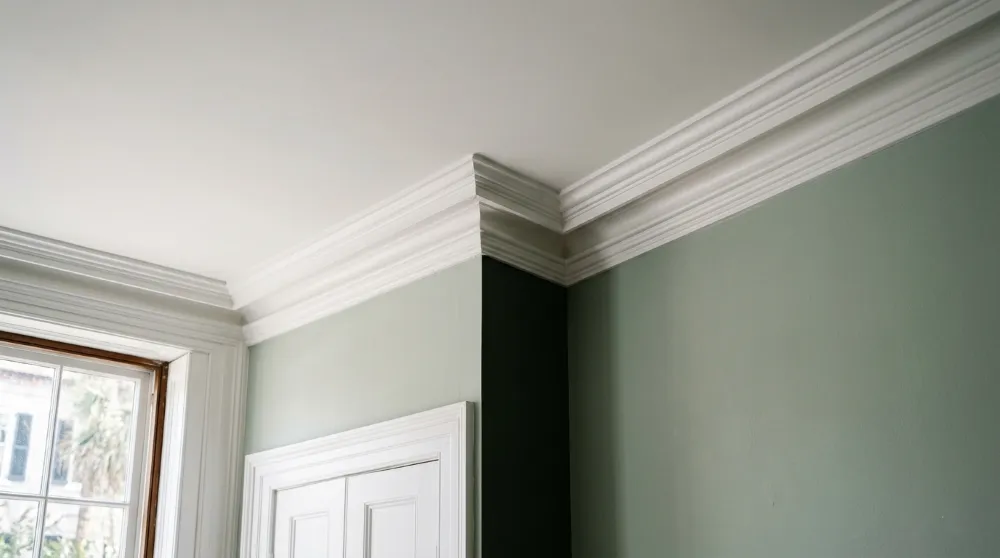
Crown molding runs along the top of the wall where it meets the ceiling, so it has one big difference from baseboard: nothing interrupts it. Doors and windows sit below it, so you run the full room perimeter with no deductions - then add a bit more for the corners, which eat material.
Skip the math
Enter your room in the baseboard calculator and tick the second profile option - it sizes crown molding (or coving, or picture rail) off the full perimeter and tells you how many lengths to buy. This guide is the method behind it.
The quick formula
perimeter = 2 × (length + width)        (full perimeter - no door deductions)
lengths   = ceil( perimeter × waste ÷ stock length )
Use a slightly higher waste allowance than for baseboard - 10% on a simple room, 15% or more with lots of corners - because each compound-angle corner cut can waste an offcut.
Crown molding by room size
Ceiling perimeter for a rectangular room - the full crown run, before adding corner waste:
| Room size | Ceiling perimeter | With 15% waste |
|---|---|---|
| 8 × 10 ft | 36 ft | ~42 ft |
| 10 × 12 ft | 44 ft | ~51 ft |
| 12 × 12 ft | 48 ft | ~55 ft |
| 12 × 15 ft | 54 ft | ~62 ft |
| 15 × 20 ft | 70 ft | ~81 ft |
| 20 × 20 ft | 80 ft | ~92 ft |
Corners are where the waste goes
Crown is cut at a compound angle, so corners are the hard part and the main reason to over-order:
- Inside corners are usually coped - the end of one piece is scribed to the profile of the other for a tight joint that does not open up as the house moves.
- Outside corners are mitred, and a small error shows badly at eye-down-the-wall angles.
- Vaulted or sloped ceilings change the spring angle, so the corner cuts are not the usual 45° - the run is still the perimeter, but add more waste for trial cuts.
Buy a spare length purely for practice cuts and you will waste less of the real material.
Worked example
A 12 ft × 15 ft room, crown molding in 16 ft lengths, 15% waste for the corners:
- Ceiling perimeter: 2 × (12 + 15) = 54 ft (no doorways deducted).
- Add 15% waste: 54 × 1.15 = 62.1 ft.
- Lengths: 62.1 ÷ 16 = 3.9, rounded up = 4 lengths.
Order whole lengths, keep one back for practising the corner cuts, and if you are running baseboard in the same room see how much baseboard do I need for the floor run.
Frequently asked questions
How much crown molding do I need for a 12x12 room?
A 12 × 12 ft room has a 48 ft ceiling perimeter, and crown runs the whole way round with no doorway deductions. Add about 10-15% for the mitred and coped corners and the offcuts, so buy around 55 ft - in 16 ft lengths that is 4 lengths. Corners eat material because each one needs a clean mitre or cope cut, and the short offcuts often cannot be reused.
Do you subtract doors and windows from crown molding?
No. Crown molding sits where the wall meets the ceiling, above the doors and windows, so it runs the full room perimeter uninterrupted. That is the opposite of baseboard, which stops at each doorway. Measure the perimeter as 2 × (length + width) and do not deduct anything - then add waste for the corners.
How much extra crown molding should I buy for corners?
Add more than you would for baseboard - 10% on a simple square room, 15% or more where there are many corners, because crown is cut at a compound angle and a mis-cut corner wastes a whole offcut. Inside corners are usually coped (one piece scribed to the other) and outside corners mitred, and both consume the end of a length. Always have a spare length for practice cuts.
How do I do crown molding on a vaulted or cathedral ceiling?
On a sloped or vaulted ceiling the spring angle changes, so the corner cuts are not the usual 45°, but the quantity is worked out the same way - the linear run is still the perimeter of the room at the crown line. Measure each wall's run along the top, add them up, and add extra waste because the angled corners are fiddlier and more likely to need a second attempt.
How many lengths of crown molding is that?
Take the perimeter, add 10-15% for corners and waste, then divide by the length of one stick (commonly 8, 12 or 16 ft) and round up. Longer lengths mean fewer joints on long walls, which matters more for crown than baseboard because a scarf joint in crown is harder to hide. The calculator's second-profile option does this from the same room you enter for the baseboard.