
Pool Maintenance: Weekly, Monthly and Seasonal
Pool maintenance is about twenty minutes a week and one bigger job at each end of the season. This is the schedule, what each task is for, and the honest comparison between doing it yourself and paying someone.
By the Calculate My Reno Team / Published
Skip to the tool
Open the Pool Volume Calculator
The reputation is worse than the reality. An established pool in good order takes fifteen to thirty minutes a week, plus one substantial job at each end of the season. The expense and the misery both come from the weeks you skip.
The weekly routine
| Task | Why |
|---|---|
| Skim the surface | Debris that sinks becomes a stain and a chlorine consumer. Catching it floating is a minute; catching it on the floor is a vacuum |
| Empty skimmer and pump baskets | A full basket starves the pump, which is bad for circulation and worse for the pump |
| Brush walls, steps and corners | Algae starts where water moves least - behind the ladder, in the corners, on the steps. The brush is the cheapest algaecide you own |
| Test chlorine and pH | Twice a week in season. More in a heatwave or after a party or a storm |
| Dose to correct | Alkalinity first, pH second, sanitizer last, one at a time |
| Check the water level | It should sit around the middle of the skimmer opening. Low, and the pump can draw air |
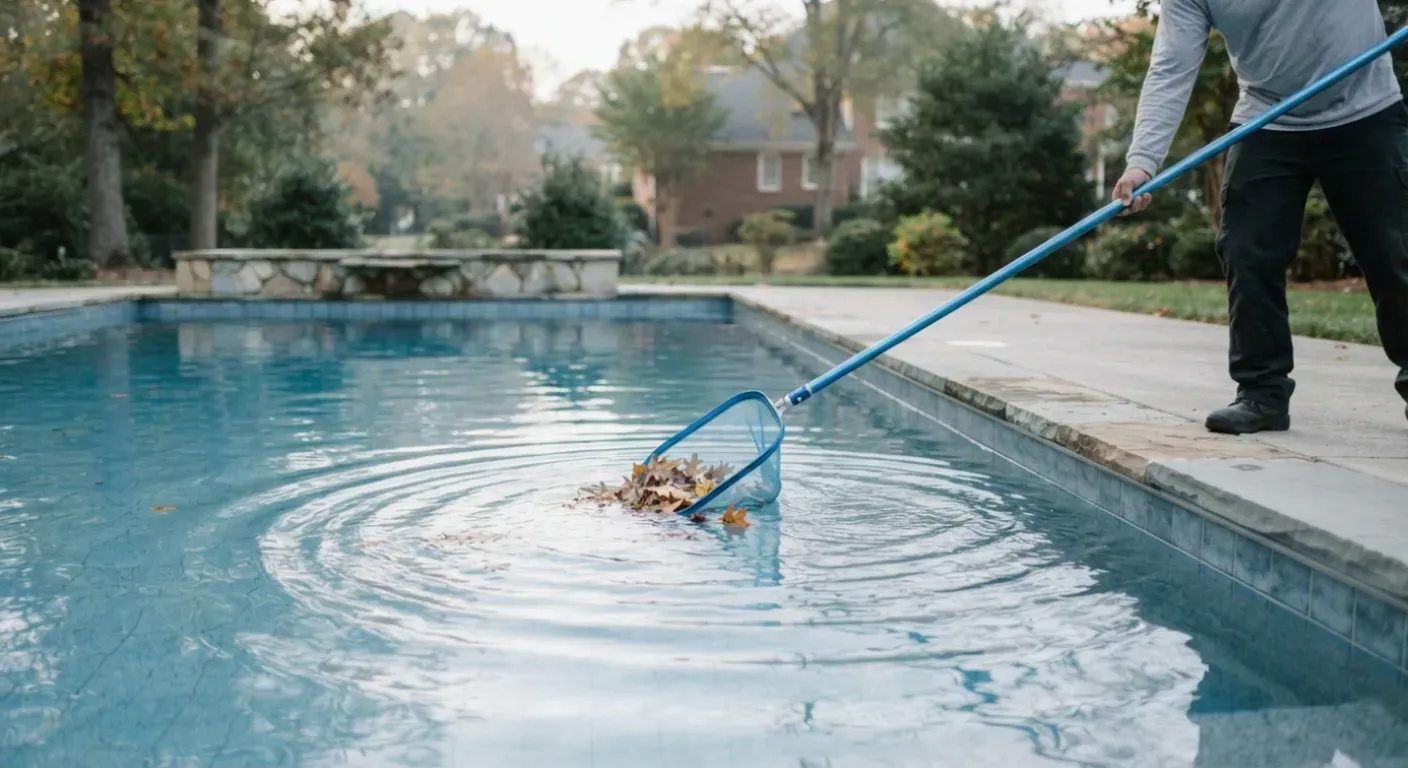
Skim, empty, brush, test, dose. That is the whole thing.
Monthly
- Full water test - total alkalinity, calcium hardness and cyanuric acid, not just the two you check weekly. These drift slowly and are behind most stubborn problems.
- Filter check. Backwash a sand or DE filter when the pressure gauge rises about 8 to 10 psi over its clean reading; rinse a cartridge on the same signal. Backwashing on a calendar rather than on the gauge wastes water and actually reduces filtration - a slightly dirty sand bed filters better than a spotless one.
- Look at the equipment pad. Drips, weeping seals, a pump that has got noisier, a salt cell with scale on the plates. Every one of these is cheap now and expensive later.
- Empty and hose the pump basket properly, rather than just tipping the leaves out.
Seasonal
Opening is a full test and rebalance, reconnecting and priming the equipment, a shock, and usually a couple of days of running the filter to clear the winter out.
Closing is the one worth doing carefully, because the failures are structural rather than cosmetic: balance the water so it does not spend the winter etching or scaling the surfaces, lower the level if your climate needs it, blow out and plug the lines, and cover it. A freeze in a line that was not cleared is the most expensive mistake in pool ownership, and it happens over a weekend nobody was watching.
What actually drives the running cost
Four lines, and their order surprises people:
running cost = electricity (the pump, and a heater if you have one)
             + chemicals
             + water (evaporation, backwashing, top-ups)
             + repairs and replacements
Electricity is usually the biggest line, not chemicals - the pump runs for hours every day all season. This is why variable-speed pumps have become the default replacement: running longer at a lower speed moves the same volume of water for substantially less power, because a pump’s power draw falls much faster than its flow rate does as you slow it down.
Chemical cost tracks your volume and your discipline in roughly equal measure. Volume you cannot change, and you should know it - get it once from the pool volume calculator, because every dose you will ever buy is priced per 10,000 gallons. Discipline you can: water held in band consumes far less chlorine than water that swings, and a green recovery costs more in one week than months of routine dosing.
Repairs are the line that is not annual and is not small. Pumps, heaters, filters, salt cells, covers and liners all have finite lives. Budgeting as though the season cost is the real cost is how a pool becomes a nasty surprise.
DIY versus a pool service
The tasks are not hard and the equipment is not specialized. What you are buying from a service is that it happens every week, and a set of eyes that has seen a failing pump seal before.
Doing it yourself makes sense when you are home most weeks, the pool is straightforward, and you are willing to test rather than eyeball. The saving is real, because labor is most of a service bill.
A service makes sense when the pool is a rental or a second home, when travel means unattended weeks in high season, or when the pool has fought you for a full year and you would rather buy the problem away. It is also the right call for equipment work - diagnosis, parts and warranties are where a company is genuinely better resourced than you are.
And the split most owners land on: do the weekly routine yourself, buy the opening, the closing and anything on the equipment pad. It keeps the recurring cost low and puts a professional on the two jobs where a mistake is expensive.
⚠️ Compare quotes on scope, not on the monthly figure. Weekly against fortnightly, chemicals included against billed separately, filter cleans and openings in or out - the same headline price can describe very different arrangements. Ask what is excluded before you compare anything.
Where pool budgets go wrong
- Counting chemicals and forgetting the pump. The electricity is usually the larger number.
- Backwashing on a schedule. Use the pressure gauge. You are throwing away water and filtration otherwise.
- Dosing against a guessed volume. Every chemical error you make for the next ten years inherits that one mistake.
- Skipping the monthly full test. Alkalinity, hardness and stabilizer are the readings that quietly cause the problems you blame on chlorine.
- Closing in a hurry. The cheapest half day of the year to do properly.
If the water is the thing fighting you rather than the routine, start with pool chemicals for what each product is for, and how to lower pH in a pool for the reading that moves most.
Frequently asked questions
How much time does pool maintenance take?
For an established pool in good order, roughly fifteen to thirty minutes a week: skim, empty the baskets, brush the walls and steps, test the water and dose it. Add an hour or so a month for a filter check and a full test. Opening and closing are each a half day. The time goes up sharply when something has been allowed to drift - chasing green water back to clear costs far more hours than keeping it clear ever did.
What does a pool service do that I cannot?
Very little of the weekly routine, honestly - the value is that it happens every week whether or not you feel like it. Where a service genuinely earns its money is the diagnostic side: recognizing a failing pump seal, a cell at the end of its life or a slow leak before it becomes an expensive repair, and having the parts and the accounts to fix it. Equipment work and closings are the parts most worth buying.
How often should I test my pool water?
Test chlorine and pH twice a week in season, and more often in hot weather or after heavy use or a storm - both burn through sanitizer fast. Test the slower readings - total alkalinity, calcium hardness and cyanuric acid - about once a month, and again at opening. Those three drift quietly and are usually the reason a pool that looks well managed keeps misbehaving.
Should I run the pool pump all day?
The pool needs its whole volume turned over, and how long that takes depends on your volume and your pump's flow rate rather than on a fixed number of hours. Work out the turnover from those two figures and run the pump long enough to achieve it, split across the day if you like. A variable-speed pump running longer at a lower speed generally moves the same water for markedly less electricity, which is why they have become the default on replacement.
Is it cheaper to maintain a pool yourself?
On cash, yes - you are paying for chemicals and electricity rather than chemicals, electricity and labor, and labor is most of a service bill. The real question is consistency. A pool left for three weeks in August costs more to recover than several months of service would have, so the comparison is not DIY against a service, it is DIY-done-weekly against a service. Many owners split it: do the weekly routine themselves and buy the opening, the closing and the equipment work.
What happens if I skip a week?
One quiet week in mild weather is usually recoverable with a shock and a good brush. A week of heat, sun and swimmers is different: chlorine goes, algae takes hold on the surfaces you did not brush, and clearing it takes days of high chlorine, filter runs and backwashing. This is why the routine is built around brief and frequent rather than thorough and occasional.