
Rebar Size Chart
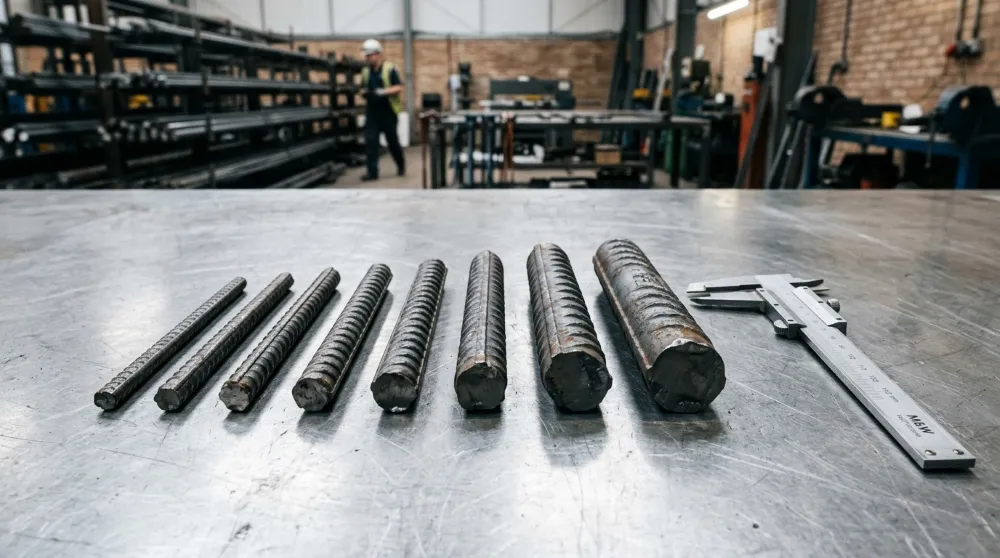
A full rebar size chart: US #-bars (#3 to #11) with diameter and weight per foot, the metric bars (10, 12, 16, 20 mm) used in the UK, Australia and beyond, and Canadian M-bars - with what each designation means and the weight per foot and per metre.
By the Calculate My Reno Team / Published
Skip to the tool
Open the Reinforcing Bar (Rebar) Calculator
Rebar comes in a fixed set of standard sizes, named differently around the world. This is the reference chart - US imperial #-bars and the metric bars - with the diameter and the weight per foot and per metre.
Just want to know which size to use? For most home jobs it is #3 or #4 (10 or 12 mm) for slabs and paths, stepping up to #5 (16 mm) for driveways and footings - your design or local code has the final say. The slab and footing guides cover the practical choice; this page is the full size reference.
Skip the math
Pick your bar in the rebar calculator - it carries these sizes and weights for your region - and it works out the quantity and total weight. This guide is the reference for the sizes themselves.
What the designation means
- US #-bars - the number is the diameter in eighths of an inch. #4 = 4/8 = 1/2 in. Exact through #8 (1 in).
- Metric (UK, AU, NZ and most of the world) - named by diameter in millimetres: 10, 12, 16, 20 mm. The UK prefixes them H (H12 = 12 mm high-yield, to BS 4449); Australia and New Zealand prefix N (N12 = 12 mm normal-ductility 500 MPa, to AS/NZS 4671).
- Canadian M-bars - the number is the cross-sectional area in roughly hundreds of mm², not the diameter, to CSA G30.18. 10M ≈ 100 mm² (11.3 mm), 15M ≈ 200 mm² (16 mm).
US rebar size chart
| Bar | Diameter | Weight (lb/ft) | Weight (kg/m) |
|---|---|---|---|
| #3 | 3/8 in (9.5 mm) | 0.376 | 0.560 |
| #4 | 1/2 in (12.7 mm) | 0.668 | 0.994 |
| #5 | 5/8 in (15.9 mm) | 1.043 | 1.552 |
| #6 | 3/4 in (19.1 mm) | 1.502 | 2.235 |
| #7 | 7/8 in (22.2 mm) | 2.044 | 3.042 |
| #8 | 1 in (25.4 mm) | 2.670 | 3.973 |
| #9 | 1.128 in (28.7 mm) | 3.400 | 5.060 |
| #10 | 1.270 in (32.3 mm) | 4.303 | 6.404 |
| #11 | 1.410 in (35.8 mm) | 5.313 | 7.907 |
Metric rebar size chart
UK H-bars and Australian/NZ N-bars share these diameters and weights:
| Bar | Diameter | Weight (kg/m) | Weight (lb/ft) |
|---|---|---|---|
| 8 mm (H8 / N/A) | 8 mm | 0.395 | 0.27 |
| 10 mm (H10 / N10) | 10 mm | 0.617 | 0.41 |
| 12 mm (H12 / N12) | 12 mm | 0.888 | 0.60 |
| 16 mm (H16 / N16) | 16 mm | 1.578 | 1.06 |
| 20 mm (H20 / N20) | 20 mm | 2.466 | 1.66 |
| 25 mm (H25 / N25) | 25 mm | 3.854 | 2.59 |
| 32 mm (H32 / N32) | 32 mm | 6.313 | 4.24 |
Canadian M-bar chart
| Bar | Diameter | Area | Weight (kg/m) |
|---|---|---|---|
| 10M | 11.3 mm | 100 mm² | 0.785 |
| 15M | 16.0 mm | 200 mm² | 1.570 |
| 20M | 19.5 mm | 300 mm² | 2.355 |
| 25M | 25.2 mm | 500 mm² | 3.925 |
| 30M | 29.9 mm | 700 mm² | 5.495 |
Metric bar weight follows 0.00617 × (mm diameter)² kg/m; Canadian M-bars follow area × 0.00785. For the weight side in detail see how much does rebar weigh, and to turn it into a quantity see how much rebar do I need.
Frequently asked questions
What size is #4 rebar?
A #4 bar is 1/2 inch (12.7 mm) in diameter and weighs 0.668 lb/ft (0.994 kg/m). The US bar number is the diameter in eighths of an inch, so #4 is 4/8 = 1/2 in, #3 is 3/8 in and #5 is 5/8 in. The rule is exact through #8 (1 in); the larger bars are slightly bigger than the simple eighths figure.
What are the standard rebar sizes?
In the US, #3 through #11 (plus #14 and #18) are standard, sized in eighths of an inch. In metric markets the common bars are 8, 10, 12, 16, 20, 25 and 32 mm - shown as H10, H12 in the UK (BS 4449) and N12, N16 in Australia and New Zealand (AS/NZS 4671). Canada uses 10M, 15M, 20M and up (CSA G30.18), sized by cross-sectional area.
What does the rebar number mean?
A US rebar number is the nominal diameter in eighths of an inch: #4 = 4/8 = 1/2 in. Metric bars are named directly by their diameter in millimetres, often with a grade prefix (H for high-yield in the UK, N for normal-ductility 500 MPa in Australia/NZ). Canadian M-bars are different again - the number is the cross-sectional area in roughly hundreds of square millimetres, so 10M is about 100 mm² and 11.3 mm across.
Is #4 rebar the same as 12mm?
Almost - a #4 bar is 12.7 mm and a 12 mm metric bar is 12.0 mm, so they are close but not identical. A #4 is a touch heavier (0.668 lb/ft vs 0.597 lb/ft for 12 mm). They are the usual swap when matching an imperial detail to a metric supplier, but check your design before substituting.
How is metric rebar weight calculated?
Metric bar mass in kg/m is about 0.00617 × (diameter in mm)², which comes from steel at 7,850 kg/m³ (the same as the d²/162 rule). So a 12 mm bar is 0.00617 × 144 = 0.888 kg/m and a 16 mm bar is 1.578 kg/m. Canadian M-bars are sized by area instead, so their weight is the nominal area in mm² × 0.00785.