
Sprinkler Pipe Size Chart
Pipe too small chokes flow and bleeds pressure to friction; too big wastes money. Here is the velocity rule, a PVC pipe size chart by GPM, and how to size your mains and laterals.
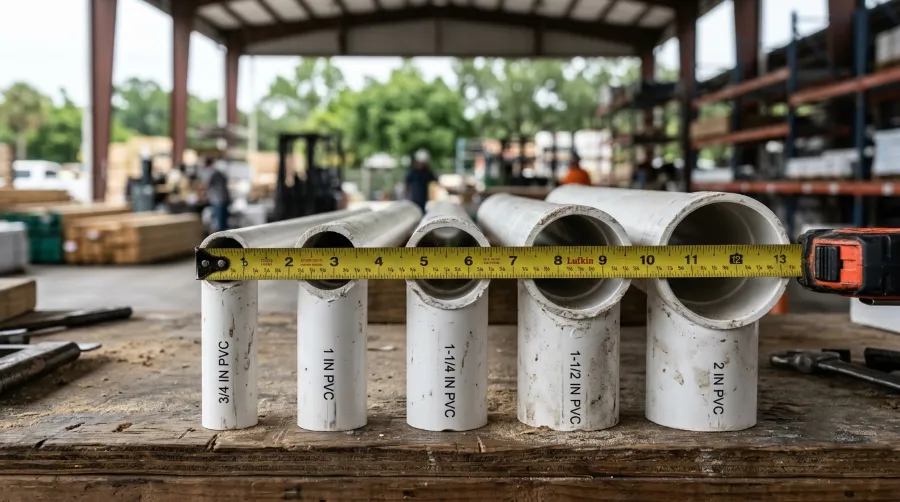
By the Calculate My Reno Team / Published
Skip to the tool
Open the Pipe Size & Friction Loss Calculator
Pipe size is a balance: too small and friction steals your pressure, too large and you have paid for pipe you did not need. The rule that settles it is velocity.
The velocity rule
Keep water moving no faster than about 5 ft/s (1.5 m/s). Above that, friction loss climbs steeply, pressure drops along the run, and a closing valve can cause water hammer. The pipe size calculator works out the velocity and friction loss for any flow, size and material, and gives the minimum size that stays under the limit.
Sprinkler pipe size chart (PVC, by GPM)
Approximate maximum flow to stay at or under 5 ft/s, Schedule 40 PVC:
| Nominal size | Actual bore | Max flow (≈5 ft/s) |
|---|---|---|
| 3/4 in | 0.824 in | ≈ 8 GPM |
| 1 in | 1.049 in | ≈ 13 GPM |
| 1-1/4 in | 1.380 in | ≈ 22 GPM |
| 1-1/2 in | 1.610 in | ≈ 30 GPM |
| 2 in | 2.067 in | ≈ 50 GPM |
Nominal size is not the bore - 1 inch Schedule 40 actually measures about 1.049 inch inside - so size on the actual inside diameter, and confirm it against the pipe’s spec.
Mains vs laterals
- Mainline - the pipe from the supply to the valves. Only one zone runs at a time, so it only ever carries the flow of the largest single zone - which is usually close to your full supply flow. Size it to that, not to the sum of every zone.
- Laterals - the pipe from each valve out to that zone’s heads; size each to its own zone’s flow, which is smaller.
Because zones run one at a time, the mainline never needs to carry more than the busiest single zone.
Friction loss
Friction loss rises roughly with the square of the flow and falls fast as the bore grows, which is why one size up makes such a difference on long runs. The pipe size calculator uses the Hazen-Williams equation to put a real psi figure on it for your length and material - handy when you are deciding whether a long run justifies the next size up.
How to size yours
- Get your total and per-zone flow from the irrigation calculator.
- Put each flow into the pipe size calculator and read off the velocity and the minimum size.
- On long runs, go one size up to keep friction loss low - see PVC vs poly pipe for the material choice.
Frequently asked questions
What size pipe do I need for a sprinkler system?
Size the pipe so water moves no faster than about 5 ft/s (1.5 m/s) - faster than that bleeds pressure to friction and risks water hammer. As a rough guide in Schedule 40 PVC: 3/4 inch carries up to about 8 GPM, 1 inch up to about 13 GPM, 1-1/4 inch up to about 22 GPM, and 1-1/2 inch up to about 30 GPM. Size the mainline to your largest single zone's flow - the most that ever runs at once - and each lateral to its own zone's flow.
What happens if irrigation pipe is too small?
Water has to move faster to push the same flow through a smaller bore, and friction loss climbs steeply - roughly with the square of the flow - so pressure drops along the run and the far heads throw short. Fast flow also causes water hammer, the bang when a valve shuts, which stresses fittings. Going one size up on long runs is cheap insurance.
Does pipe size affect water pressure?
Yes. Pipe size does not create pressure, but undersized pipe loses it to friction as water speeds up to get through. Keep velocity at or below 5 ft/s and friction loss stays small; exceed it and you can lose several psi over a long run, leaving little at the heads. The pipe size calculator shows the velocity and friction loss for any size and flow.