
PVC Pipe Sizes for Irrigation
PVC is the common rigid irrigation pipe, sold in a handful of standard sizes. Here are the sizes used in a sprinkler system, how PVC compares with flexible poly pipe, and where each one belongs.
By the Calculate My Reno Team / Published
Skip to the tool
Open the Pipe Size & Friction Loss Calculator
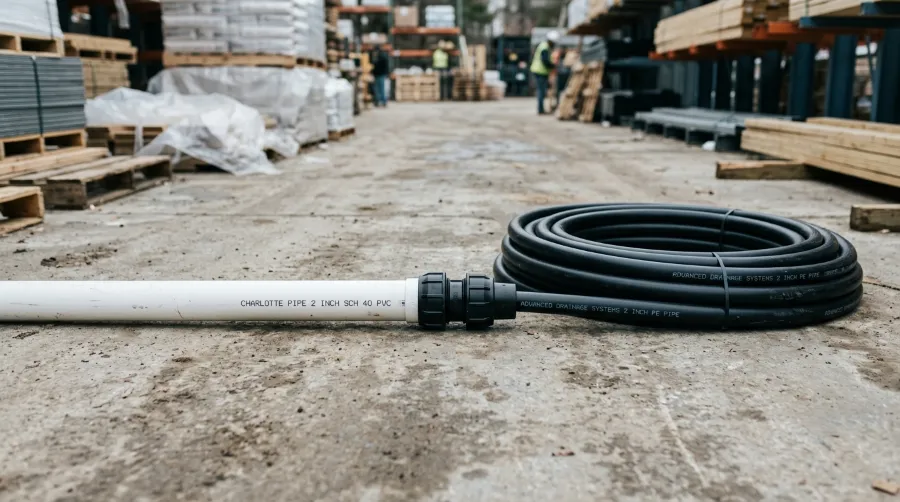
PVC and polyethylene (poly) are the two common irrigation pipes. They carry water equally well - the difference is how they are joined, how they handle cold, and where each makes sense.
Side by side
| PVC (rigid) | Poly / PE (flexible) | |
|---|---|---|
| Form | Rigid lengths | Flexible coils |
| Joining | Solvent-welded (glued) | Barb/insert + clamps |
| Freeze resistance | Can crack | Flexes, resists better |
| Best for | Mainlines, straight runs, warm climates | Laterals, curves, cold climates |
| Above ground | Yes (UV-resistant types) | Usually buried |
| Bore (sizing) | Smooth | Smooth |
Where each is used
- PVC - the mainline from the supply to the valve manifold, and straight lateral runs, especially in warm regions. It is stiff, cheap by the foot, and glued joints are permanent and strong.
- Poly - the flexible runs from each valve out to the heads, around curves and obstacles, and the default for laterals in cold climates where its give resists freeze damage.
Plenty of systems use both: a glued PVC mainline and manifold, then poly out to the heads, joined with transition fittings.
PVC pipe sizes for irrigation
Irrigation PVC comes in a handful of standard nominal sizes - 1/2”, 3/4”, 1”, 1-1/4”, 1-1/2” and 2” - and the right one for each run depends on the flow (GPM) it carries, not on the material. Both PVC and poly have smooth bores and similar friction characteristics (a Hazen-Williams C around 150), so the size you need for a given flow is about the same either way. What matters most is keeping velocity at or below 5 ft/s - check it in the pipe size calculator, which lets you pick the material.
Climate is the deciding factor
- Warm, no hard freeze - PVC throughout is fine and cheap.
- Cold winters - poly for laterals, and winterize (blow out) the system before a freeze regardless of pipe.
Putting it together
Work out your zone flows in the irrigation calculator, size each run in the pipe size calculator, then pick PVC or poly per the table for each part of the system.
Frequently asked questions
Should I use PVC or poly pipe for irrigation?
Use rigid PVC for mainlines and where pipe runs straight or above ground, especially in warm climates; use flexible polyethylene (poly) pipe for laterals, curved runs and cold climates where its flexibility resists freeze damage. Many systems use both - PVC for the mainline and manifold, poly for the runs out to the heads. Both have similar smooth bores, so pipe sizing is much the same.
Does poly pipe resist freezing better than PVC?
Yes. Polyethylene is flexible and can expand a little if water freezes inside, so it tolerates freeze cycles far better than rigid PVC, which can crack. In cold climates poly is the common choice for laterals, though you should still blow out (winterize) any system before a hard freeze whatever the pipe.
Can I connect PVC to poly pipe?
Yes, with the right transition fitting - typically a threaded or barbed/clamp adapter that takes the glued PVC on one side and the clamped or insert poly on the other. It is common to run a PVC mainline to the valves and switch to poly for the flexible runs out to the heads, joined with these adapters.