
Zoysia Grass
Zoysia makes a dense, hard-wearing, drought-tough lawn with a soft feel - if you can wait for it. Most varieties are laid as sod or plugs, only a couple come from seed, and all of them establish slowly. Here is how to choose and care for it.
By the Calculate My Reno Team / Published
Skip to the tool
Open the Turf & Grass Seed Calculator
Zoysia is a warm-season grass known for a dense, fine-to-medium lawn that feels soft underfoot, tolerates heat, drought and foot traffic, and crowds out weeds once established. The catch is patience: it is one of the slowest grasses to fill in.
Seed or sod?
Unlike St. Augustine, a few Zoysia varieties can be grown from seed - Zenith and Compadre are the common seeded types. But the premium varieties most people are after are sterile or do not come true from seed, so they are sold only as sod or plugs:
- From seed: Zenith, Compadre - cheaper to establish, but still slow.
- Sod or plugs only: Zeon, Emerald, Meyer, Cavalier, Palisades, Empire.
If you want a named premium Zoysia, plan a sod job - the sod calculator gives the pallets. If budget matters more than the exact variety, a seeded Zenith lawn is the lower-cost route (switch the calculator to seed mode).
The main varieties
| Variety | Established by | Notes |
|---|---|---|
| Emerald | Plugs / sprigs | Fine-textured, dense; slow to establish |
| Meyer | Plugs / sprigs | Good cold tolerance; the classic “Amazoy” type |
| Zeon | Sod / plugs | Soft, fine, fast-spreading for a Zoysia; heat and drought tough |
| Empire | Sod / plugs | Wide-bladed, very traffic-tolerant; can build thatch |
| Zenith | Seed or sod | Cold-tolerant, faster-growing, tolerates light shade |
Strengths and the slow-growth trade-off
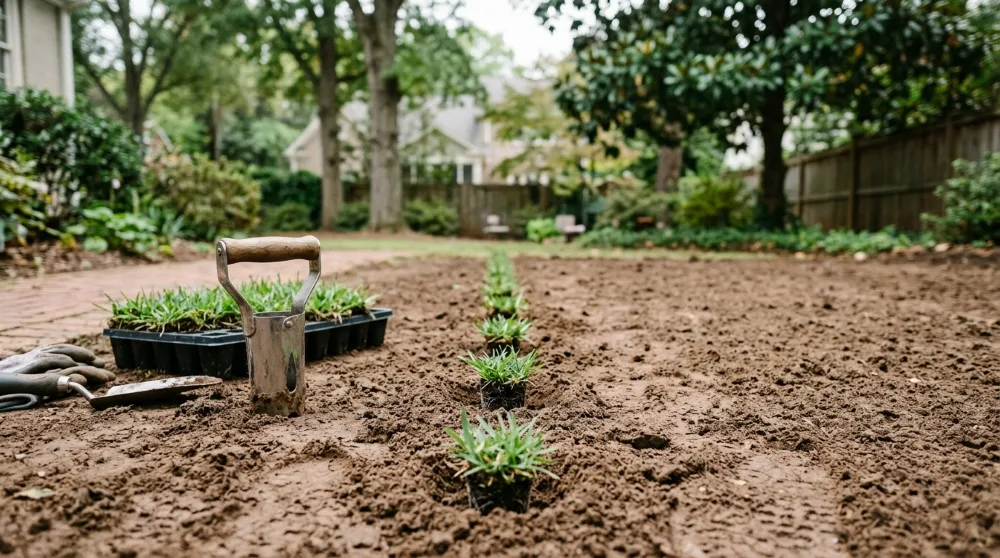
Zoysia’s appeal is density and toughness: a mature Zoysia lawn is thick enough to resist weeds, handles drought and heat well, takes foot traffic, and tolerates light shade better than Bermuda. Its drawback is establishment speed - from plugs it can take one to three seasons to fill in, and it is slower than Bermuda to recover from damage. Laying full sod rather than plugs is the way to get cover sooner.
Care basics
- Mow lower than St. Augustine - around 1 to 2 inches, depending on variety - with a sharp blade.
- Water deeply but infrequently; established Zoysia is notably drought-tolerant.
- Dethatch wide-bladed types like Empire if thatch builds up over the years.
- Feed lightly - Zoysia needs less nitrogen than many lawns, and over-feeding worsens thatch.
Planning a Zoysia lawn
For a sodded variety, the job is the same as any turf: a clean, level bed topped up with topsoil where needed, laid promptly. Use how much sod do I need for quantities and how much does sod cost to budget - Zoysia is a premium-priced sod. Comparing it against the South’s other favourite, see St. Augustine grass, and weigh sod against seed in sod vs seed.
Frequently asked questions
Can you grow Zoysia grass from seed?
A few varieties, yes - Zenith and Compadre are sold as seed and establish reasonably well. But the premium varieties most people want, such as Zeon, Emerald, Cavalier and Palisades, are sterile or do not come true from seed, so they are only available as sod or plugs. If you specifically want a named premium Zoysia, you will be laying turf; if you are happy with a seeded type, Zenith is the usual choice.
How long does Zoysia grass take to establish?
Slowly - that is Zoysia's main drawback. From plugs or sprigs it can take one to three growing seasons to knit into a full lawn, and even from sod it is slower to recover and fill than Bermuda. The pay-off is a dense, tough, weed-resistant lawn once it is in. If you want quicker cover, lay it as full sod rather than plugs, and be patient with the spread.
Is Zoysia better than Bermuda or St. Augustine?
It depends on the lawn. Zoysia is denser and finer than Bermuda and handles light shade better, but Bermuda recovers faster from wear. Against St. Augustine, Zoysia is finer-bladed, more cold-tolerant and more traffic-tolerant, but St. Augustine handles shade better. Zoysia's strengths are density, drought tolerance and a soft, even feel underfoot; its weakness is slow establishment and recovery.