
Insulation R-Value Chart
New to insulation? R-value is simply how well it slows heat - higher means warmer in winter and cooler in summer. This guide helps you pick the right R-value for each part of your home and your climate, shows the depth it needs, and converts between the US, metric (RSI) and U-value scales.
By the Calculate My Reno Team / Published
Skip to the tool
Open the Loft & Wall Insulation Calculator
Insulation works by slowing the heat trying to escape your home in winter - or get in over summer - and R-value is the number that tells you how much it slows it. Higher is better. There is no single “right” R-value, though: it depends on which part of the house you are insulating, your climate, and how much depth you have to fill. This guide walks through those three, then gives the conversion and depth charts as reference.
Start here: the three things that set your R-value
- Where it goes. The roof or ceiling loses the most heat and takes the highest R-value; walls come next; floors the least. If you only insulate one thing, make it the ceiling.
- Your climate. The colder your winters (or hotter your summers), the higher the R-value earns its keep. The same house in a colder town wants a higher target.
- The space you have. A 2×4 (90 mm) wall only fits so much insulation. If you cannot get the depth, a denser, higher-performance product reaches the target R-value in less room.
Nail those three and you have your number. Everything below is the detail.
What R-value for each part of the house
The biggest lever is where the insulation goes, because each area takes a different target:
| Where it goes | US R-value | Metric R (AU/NZ/UK) | Notes |
|---|---|---|---|
| Roof / ceiling / attic | R-30 to R-60 | R3.5 to R6.0 | Biggest heat loss - do this first |
| Exterior walls | R-13 to R-21 | R2.0 to R2.7 | Higher in a deeper (2×6) wall |
| Floors / underfloor | R-19 to R-30 | R1.5 to R2.5 | Over an unheated space below |
These are regional norms, not exact conversions of each other - each country’s code is tuned to its own climate and construction. Treat the two columns as “what people buy here,” and check your local minimum below.
What R-value for your climate
Within those ranges, your climate decides where to land - and it matters more for the roof than the walls:
| Your climate | Ceiling / roof | Walls |
|---|---|---|
| Hot or mild | R-30 to R-38 (R3.5-R4.0) | R-13 to R-15 (R2.0-R2.5) |
| Temperate / mixed | R-38 to R-49 (R4.0-R5.0) | R-15 to R-21 (R2.5-R2.7) |
| Cold | R-49 to R-60 (R5.0-R6.0+) | R-19 to R-21 (R2.7+) |
Your building code or energy authority sets the real minimum for your exact climate zone - find yours:
- United States - US Department of Energy recommended R-values
- Canada - Natural Resources Canada
- Australia - YourHome, which follows the National Construction Code by climate zone
- New Zealand - Building Code clause H1
- United Kingdom - Building Regulations Approved Document L
A code minimum is a floor, not a target - going a step above it in the ceiling is usually the cheapest comfort upgrade you can make.
What fits your space: depth and density
R-value needs depth to sit in, so the cavity you have to fill is a real constraint. This is the typical thickness each R-value needs in standard fibreglass batt:
| R-value | Typical depth | Common use |
|---|---|---|
| R-13 / R-15 | 3.5 in / 89 mm | 2×4 exterior wall |
| R-19 / R-21 | 5.5-6.25 in / 140-159 mm | 2×6 wall, floors |
| R-30 | 8.25 in / 210 mm | Ceilings, cathedral roofs |
| R-38 | 10.25 in / 260 mm | Attic, warmer climates |
| R-49 | 13.75 in / 349 mm | Attic, cold climates |
| R-60 | 19 in / 483 mm | Attic, coldest climates |
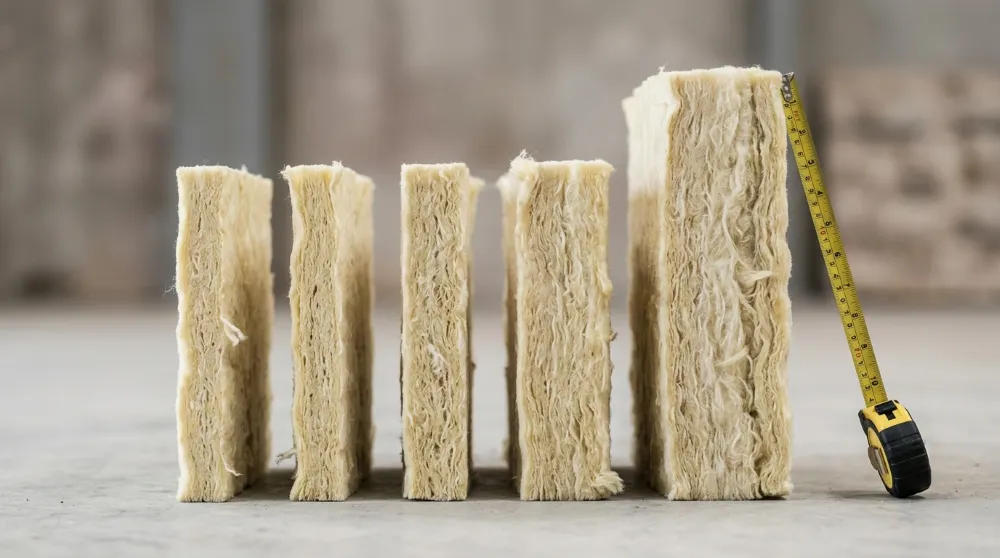
But depth is R-value × thermal conductivity (λ), so the same R-value comes in different thicknesses depending on how dense the product is. A “high-density” (HD) batt has a lower λ and reaches the R-value in less depth than a standard one: an R2.0 HD wall batt is about 75 mm where a standard R2.0 is ~90 mm, and a UK λ0.032 slab hits R2.0 in just 65 mm. (The US scale handles this by giving the denser batt a different number - R-15 is the HD version of R-13 in the same 3.5 in cavity.) So if the target won’t fit your wall, reach for a denser batt or a board with a higher R per inch:
| Material | R per inch | R-13 needs | Best when |
|---|---|---|---|
| Fibreglass batt | ~3.1 | ~3.5 in | Open stud / joist bays |
| Mineral wool batt | ~3.7 | ~3.5 in | Same, plus fire / sound |
| Blown cellulose | ~3.5 | ~3.7 in | Attics, filling cavities |
| Blown fibreglass | ~2.5 | ~5 in | Attics, light loose fill |
| Open-cell spray foam | ~3.7 | ~3.5 in | Sealing irregular gaps |
| Closed-cell spray foam | ~6.5 | ~2 in | Shallow cavities, air-sealing |
| Rigid foam (XPS) | ~5.0 | ~2.6 in | Over framing, basements |
Higher R per inch reaches the target in less depth - which is why closed-cell foam and rigid board win where the cavity is shallow. Always check the actual thickness printed on your own pack.
Reference: R-value, RSI and U-value
The same insulating property goes by three names depending on where you are:
| R-value (US) | RSI (metric) | U-value (1 ÷ R) |
|---|---|---|
| R-13 | 2.3 | 0.077 |
| R-15 | 2.6 | 0.067 |
| R-19 | 3.3 | 0.053 |
| R-21 | 3.7 | 0.048 |
| R-30 | 5.3 | 0.033 |
| R-38 | 6.7 | 0.026 |
| R-49 | 8.6 | 0.020 |
| R-60 | 10.6 | 0.017 |
RSI = R-value ÷ 5.678, and it is the figure printed on the pack in Australia, New Zealand and the UK (the UK calls it the RD value, next to the material’s conductivity λ). U-value is the inverse of R-value - lower is better - and is what building regulations quote for a finished wall or roof. R-values add in layers, so a wall is the sum of its batt, sheathing and finishes.
Putting it to use
Once you know the R-value for each area, turn it into a product count with the insulation calculator - it shows the US scale on its US and Canada pages and the metric scale on its Australian, New Zealand and UK pages. For the full method see how much insulation do I need, and for attics specifically how much attic insulation do I need. Still choosing a product? Blown-in vs batt insulation compares the two.
Frequently asked questions
What is R-value, in plain terms?
R-value measures how well insulation slows heat - the higher the number, the better it keeps warmth in during winter and out during summer. It stacks up in layers, so R-13 batts plus R-5 sheathing make an R-18 wall. The same property is called RSI (metric R-value) in Australia, New Zealand and the UK, where RSI = R ÷ 5.678, and U-value (U = 1 ÷ R) when describing a whole wall or roof - for U-value, lower is better.
How do I choose the right R-value for my home?
Three things set it: where it goes (the roof or ceiling takes the most, then walls, then floors), your climate (colder winters or hotter summers mean a higher target), and the depth you have to fill (a denser product reaches the same R-value in less space). Start with the ceiling - it is the biggest heat loss and the best payback - then walls, then floors.
What R-value do I need for my climate?
As a rough guide: hot or mild climates want about R-30 to R-38 (RSI 3.5-4.0) in the ceiling and R-13 to R-15 (R2.0-R2.5) in the walls; cold climates push the ceiling to R-49 to R-60 (R5.0-R6.0) and the walls to R-19 to R-21 (R2.7). Your building code or energy authority sets the actual minimum for your climate zone, so check it before you buy.
How do I convert R-value to RSI?
Divide the R-value by 5.678 to get RSI (the metric R-value in m²·K/W), or multiply RSI by 5.678 to go the other way. So R-13 ≈ RSI 2.3, R-30 ≈ RSI 5.3, and R-49 ≈ RSI 8.6. U-value is the inverse: U = 1 ÷ R-value, so a lower U-value means better insulation. In Australia, New Zealand and the UK the RSI figure is the one printed on the pack, so there is nothing to convert - you buy by the metric R-value directly.