
How Much Attic Insulation Do I Need?
The attic is usually the cheapest place to add insulation and the one that takes the most. Here is the R-value to aim for by climate, the depth that buys, and how to turn your attic area - in square feet or square metres - into a bag count.
By the Calculate My Reno Team / Published
Skip to the tool
Open the Insulation Calculator
The attic is the highest-leverage place to insulate: heat rises, the area is large and open, and you are usually just adding depth to a floor. The question is how much R-value to aim for, and how many bags that takes.
Pick the R-value for your climate
Attics take the highest R-values in the house. The US Department of Energy’s broad recommendation:
| Climate | Attic target |
|---|---|
| Hot (south) | R-30 to R-49 |
| Mixed (central) | R-38 to R-60 |
| Cold (north) | R-49 to R-60 |
Most older homes were built to a lower standard, so topping up an attic to R-49 or R-60 is one of the better-value energy upgrades. The insulation R-value chart lists the depth each value needs. In Australia, New Zealand and the UK, ceiling insulation is rated in metric R-values instead - commonly R5.0 to R6.0 for a ceiling - and the calculator shows that scale on those regional pages.
The formula
attic area = length × width (the attic floor)
bags       = ceil( attic area × wastage ÷ coverage per bag )
Measure the attic floor, pick the target R-value, and divide by the coverage one bag gives at that R-value. It works in either unit - an area in m² and a coverage in m² give the same bag count. Blown-in coverage falls as the R-value rises, because the fill gets deeper:
| R-value | Blown-in coverage per bag | Approx depth |
|---|---|---|
| R-30 | ~60 sq ft (5.6 m²) | 8-10 in / 200-250 mm |
| R-38 | ~47 sq ft (4.4 m²) | 10-13 in / 250-330 mm |
| R-49 | ~37 sq ft (3.4 m²) | 14-16 in / 350-400 mm |
| R-60 | ~30 sq ft (2.8 m²) | 17-19 in / 430-480 mm |
Worked example
A 1,000 sq ft (93 m²) attic, blown-in to R-49, 5% wastage:
- Area: 1,000 sq ft (93 m²).
- With wastage: 1,000 × 1.05 = 1,050 sq ft (98 m²).
- Bags: 1,050 ÷ 37 = 28.4, rounded up to 29 bags.
Drop to R-30 and the same attic is 1,050 ÷ 60 = 18 bags - the R-value is the lever. Run your attic through the insulation calculator to set the exact coverage from your bag, and add a price per bag for a material cost estimate.
Blown-in or batts?
Open attics are almost always blown-in - it is fast and fills around every joist and wire. Batts only make sense in a small or partly floored attic where you can lay them cleanly between accessible joists. See blown-in vs batt insulation for the trade-off.
Tips
- Air-seal first - caulk and foam the gaps around lights, pipes and the hatch before you add insulation, or you insulate over the leaks.
- Keep insulation off recessed lights unless they are IC-rated, and hold it back from the eaves with baffles so the soffit vents stay clear.
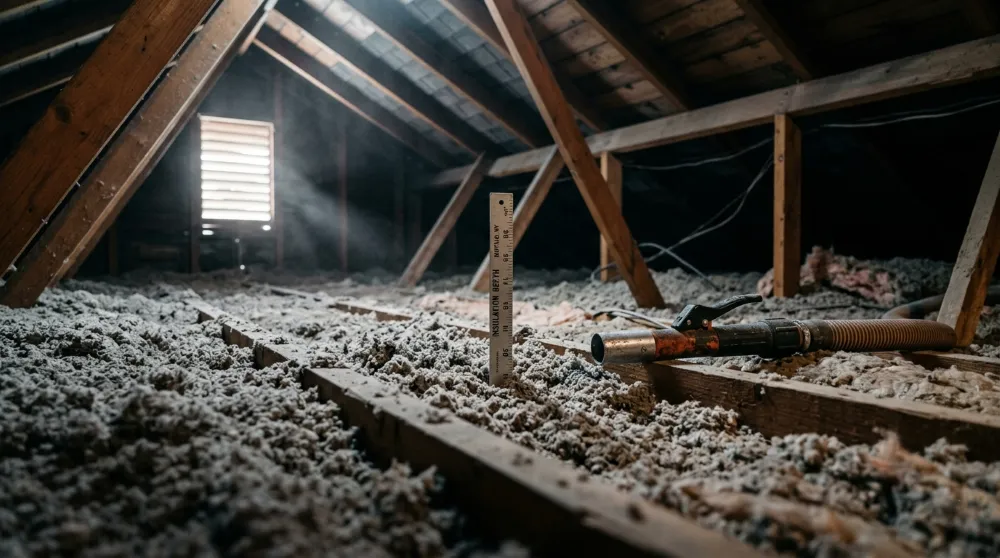
- Set depth markers to the target depth so you (and an inspector) can confirm the settled depth later.
- Insulate the attic hatch too - it is a hole in your best-insulated surface.
Frequently asked questions
What R-value do I need in my attic?
The US Department of Energy recommends roughly R-30 to R-49 for attics in warm climates and R-49 to R-60 in cold ones. As a rule of thumb, most existing homes benefit from topping up to at least R-38, and R-49 to R-60 is the target in northern climates. In Australia, New Zealand and the UK the same ceiling target is given in metric R-values - commonly R5.0 to R6.0. Check your climate zone, then size the bags for that R-value.
How many bags of blown-in insulation for a 1,000 sq ft attic?
At R-30 with a bag covering about 60 sq ft (5.6 m²) and 5% wastage: 1,000 × 1.05 ÷ 60 = about 18 bags. At R-49 the same bag covers only ~37 sq ft (3.4 m²), so the count climbs to about 29 bags - the higher the R-value, the deeper the fill and the fewer square feet each bag covers. (1,000 sq ft is about 93 m².)
How deep should attic insulation be?
Depth follows the R-value: blown-in fibreglass is roughly R-2.5 per inch and cellulose about R-3.5, so R-38 is about 11-15 inches (280-380 mm) and R-49 about 14-19 inches (350-480 mm) depending on the material. Install depth markers or a ruler so you can check the settled depth hits the rated R-value.
Can I just add insulation over old attic insulation?
Usually yes - you can lay new unfaced batts or blow loose fill straight over existing insulation to top up the R-value, as long as the old material is dry and not compressed. Do not use faced batts on top, because the vapour barrier would be trapped in the middle. Add the existing R-value and the new one to get the total.