
Concrete Block Sizes
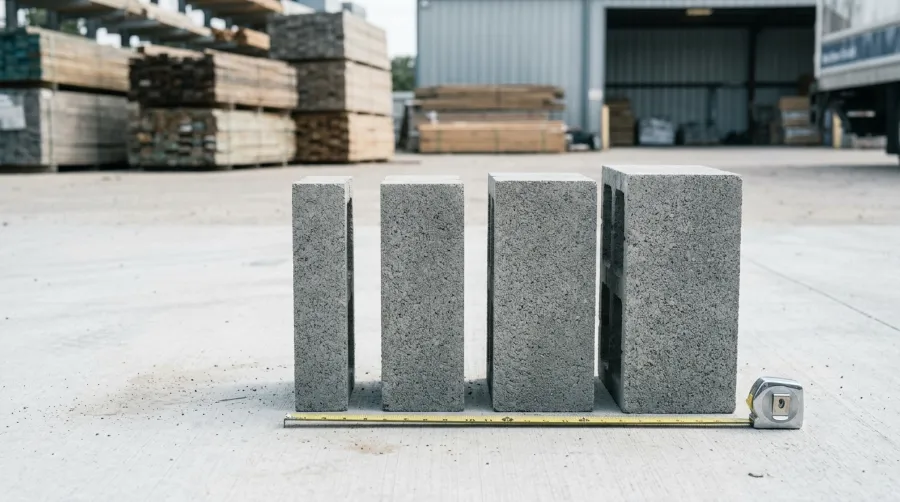
Concrete block is named by its nominal size, and the everyday US units - 4, 6, 8, 10 and 12 inch - all share the same 8 × 16 in face, so they count the same per area. Here are the sizes in inches and metric, what nominal versus actual means, and the common block shapes.
By the Calculate My Reno Team / Published
Skip to the tool
Open the Concrete Block Calculator
Concrete block - CMU (concrete masonry unit), or cinder block in older usage - is named by its nominal size. The key thing to understand is that the everyday US blocks all share one face (8 × 16 in); only the width changes.
Skip the math
Pick your block in the concrete block calculator - the presets carry the 6, 8 and 12 inch CMU and the metric block - and it works out the count and the mortar. This guide is the reference for the sizes themselves.
Nominal vs actual size
The actual size is the block as it is made; the nominal size is the actual size plus one mortar joint - the module the wall lines up to. A standard block is an actual 7-5/8 × 7-5/8 × 15-5/8 in but a nominal 8 × 8 × 16 in once you add the 3/8 in joint, so two blocks make a clean 32 in and a course of six makes 8 ft. Always estimate and lay out from the nominal size.
US concrete block sizes
The first number is the width (the wall thickness); the face is always 8 × 16 in nominal. Actual dimensions in inches (W × H × L):
| Block (nominal) | Actual (W × H × L) | Face | Per 100 sq ft |
|---|---|---|---|
| 4 × 8 × 16 in | 3-5/8 × 7-5/8 × 15-5/8 | 8 × 16 in | 112.5 |
| 6 × 8 × 16 in | 5-5/8 × 7-5/8 × 15-5/8 | 8 × 16 in | 112.5 |
| 8 × 8 × 16 in | 7-5/8 × 7-5/8 × 15-5/8 | 8 × 16 in | 112.5 |
| 10 × 8 × 16 in | 9-5/8 × 7-5/8 × 15-5/8 | 8 × 16 in | 112.5 |
| 12 × 8 × 16 in | 11-5/8 × 7-5/8 × 15-5/8 | 8 × 16 in | 112.5 |
The 8 in block is the everyday workhorse for walls and stem walls; 12 in is used for taller walls, foundations and where you need more core for grout and rebar; 6 in suits lighter walls and partitions; 4 in is a veneer or partition unit. Because the face never changes, all of them are 112.5 blocks per 100 sq ft - the width only changes the wall thickness and the mortar (and the weight of each block).
Common block shapes
Beyond the plain stretcher, the same 8 × 16 in face comes in shapes for the awkward spots:
- Stretcher - the standard block with two end webs, for the run of the wall.
- Corner / single-bullnose - one finished (square or rounded) end, for the end of a wall or a corner.
- Half block (8 × 8 × 8 in) - keeps the running bond at corners and openings without cutting.
- Bond beam / knockout - a channel along the top to lay horizontal rebar and grout, for lintels and tie beams.
- Sash / jamb - a slot in the end for a window or door frame.
These all count as one block of the same face, so the calculator’s per-area count covers them - just allow a little extra waste for the cutting at corners and openings.
Metric and UK block sizes
Length × height × width, laid with a 10 mm joint:
| Region | Block (L × H × W) | Coordinating face | Per m² |
|---|---|---|---|
| Metric / Australia | 390 × 190 × 190 mm | 400 × 200 mm | 12.5 |
| New Zealand | 390 × 190 × 190 mm | 400 × 200 mm | 12.5 |
| UK (dense / aircrete) | 440 × 215 × 100 mm | 450 × 225 mm | ~9.9 |
The metric 390 × 190 mm face gives 12.5 blocks per m²; the larger UK 440 × 215 mm face is nearer 9.9 per m². As with the US blocks, the width (100, 140, 190, 215 mm) sets the wall thickness, not the count.
Why the size matters
The face sets the count and the wall layout (the nominal 8 × 16 in or 400 × 200 mm has to divide into your wall); the width sets the wall’s strength, its insulation and its weight. For the counts by wall size, see how many concrete blocks do I need; for the handling and delivery weight of each size, see how much does a concrete block weigh.
Frequently asked questions
What is the standard concrete block size?
The standard US block is nominally 8 × 8 × 16 in - an actual 7-5/8 × 7-5/8 × 15-5/8 in, which is 3/8 in undersize on every dimension to leave room for the mortar joint. The number you hear quoted ("6 inch", "8 inch", "12 inch") is the width (the wall thickness); the face stays 8 × 16 in. The standard metric block is 390 × 190 × 190 mm.
What is the actual size of an 8x8x16 block?
An 8 × 8 × 16 in block actually measures 7-5/8 × 7-5/8 × 15-5/8 in (about 194 × 194 × 397 mm). The "8 × 8 × 16" is the nominal size: the actual unit is 3/8 in smaller each way so that, with a 3/8 in mortar joint, it modules to a tidy 8 × 8 × 16 in. Always lay out and count from the nominal size.
Do 6, 8 and 12 inch blocks count the same per area?
Yes. The 4, 6, 8, 10 and 12 inch blocks all share the same 8 × 16 in face, so all of them work out to about 112.5 blocks per 100 square feet of wall. The width only changes the wall thickness and the amount of mortar per block, not the number of blocks per area. Pick the width for the structural job; the count is the same.
What size is a metric concrete block?
The standard metric (and Australian) concrete block is 390 × 190 × 190 mm, which lays to a 400 × 200 mm coordinating face with a 10 mm joint - about 12.5 blocks per square metre. The UK also uses a 440 × 215 × 100 mm block (450 × 225 mm coordinating), which works out to about 9.9 per square metre.