
How Many Fence Posts Do I Need?
Posts are the part people run short on, and an extra trip to the yard mid-build is a pain. Here is how to count the posts and panels for any fence from two numbers: the run length and the post spacing.
By the Calculate My Reno Team / Published
Skip to the tool
Open the Fence Calculator
Posts set the cost and the work of a fence - they need digging, concreting and lining up dead straight. Get the count right before you start and the rest of the build follows easily.
The formula
A fence run is split into bays (the gaps between posts, also called panels). Bays round up so no gap is ever wider than your spacing, then you add one post to close the final bay:
bays (panels) = ceil(run length ÷ post spacing)
posts         = bays + 1
The fence calculator does this for every run and totals the posts, rails and pickets - but the two numbers that decide everything are the run length and the spacing.
Measure the run first
For a single straight fence the run length is just the length of that line. For an L-shaped, three-sided or full perimeter fence, measure each straight side separately and add it as its own run:
- A back-garden fence might be one run.
- A side-and-back fence is two runs meeting at a corner.
- A full perimeter fence is one run per side, with a post at every corner.
Adding runs separately is what gives every corner its own post instead of trying to share one across a 90-degree turn.
Picking the spacing
| Situation | Post spacing |
|---|---|
| Pre-made panels | Match the panel width (often 1.8 m / 6 ft) |
| Standard timber fence | 2.4 m (8 ft) on centre |
| Exposed or windy site | 1.8 m (6 ft) for a stiffer fence |
| Heavy rails, sheltered site | Up to 3 m (10 ft) |
If you are fitting ready-made panels, set the spacing to the panel width so each bay holds exactly one panel.
Worked example
A 60 ft run at 8 ft post spacing:
- Bays: ceil(60 ÷ 8) = ceil(7.5) = 8 bays (panels).
- Posts: 8 + 1 = 9 posts.
Add a 30 ft return as a second run and you get ceil(30 ÷ 8) = 4 bays and 5 posts, for 14 posts in total - the shared corner is counted once on each run, which is the safe way to buy.
A few tips
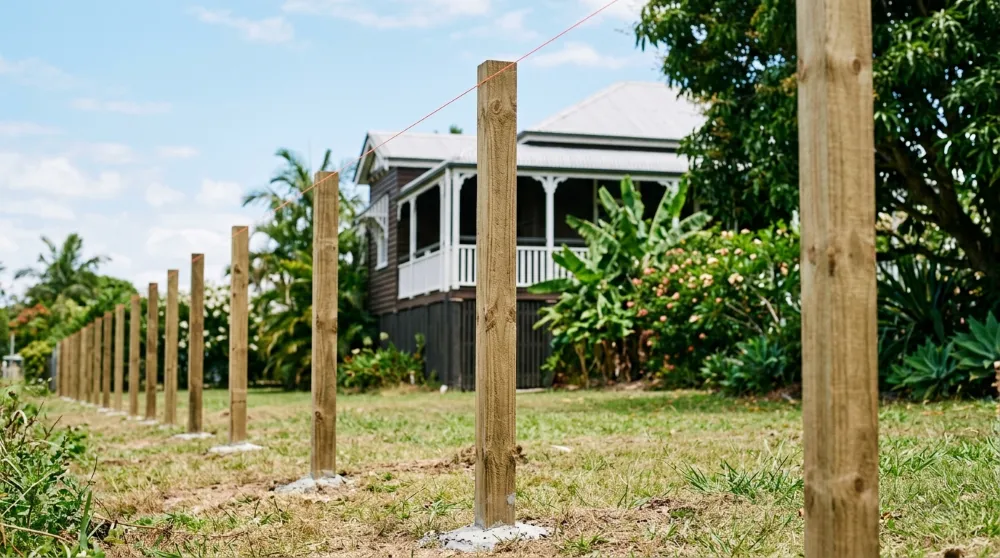
- Set the two end posts first, run a string line between them, and space the intermediate posts off the line so the fence is straight.
- Gate openings need two strong hanging and latch posts plus hardware - count those on top of the line posts.
- Each post needs concrete: see how much concrete for a fence post for hole sizing and bag counts.
- Once the posts are set, work out the cladding with how many fence pickets or boards do I need.
Frequently asked questions
How do I calculate the number of fence posts?
Divide the run length by the post spacing and round up to get the number of bays (panels), then add one for the closing post. A 60 ft run at 8 ft spacing is ceil(60 ÷ 8) = 8 bays, so 9 posts. Add each straight side of the fence as its own run and total the posts, counting a post at every corner.
How far apart should fence posts be?
Timber fence posts are usually set 1.8-3 m (6-10 ft) apart on centre, with 2.4 m (8 ft) the common default that matches standard panel and rail lengths. Use closer spacing in windy or exposed spots for a stiffer fence; wider spacing uses fewer posts but needs stronger rails. If you are using pre-made panels, the panel width sets the spacing for you.
How many posts for a 100 ft fence?
At 8 ft spacing a straight 100 ft run is ceil(100 ÷ 8) = 13 bays, so 14 posts. At 6 ft spacing it is ceil(100 ÷ 6) = 17 bays and 18 posts. Closer spacing means more posts and more concrete, so it is the spacing - not the length alone - that drives the post count.
Do corners need an extra post?
Yes. Each straight length of fence needs a post at both ends, so a corner where two runs meet gets a post for each run. Enter each side as a separate run in the calculator and it counts the junction posts for you, which keeps the estimate on the safe side.