
How Much Drywall Mud and Tape Do I Need?
Once the board is up, the joints get taped and filled. Here is how to work out the joint compound (mud) and tape from your boarded area - in boxes and rolls, not vague guesses.
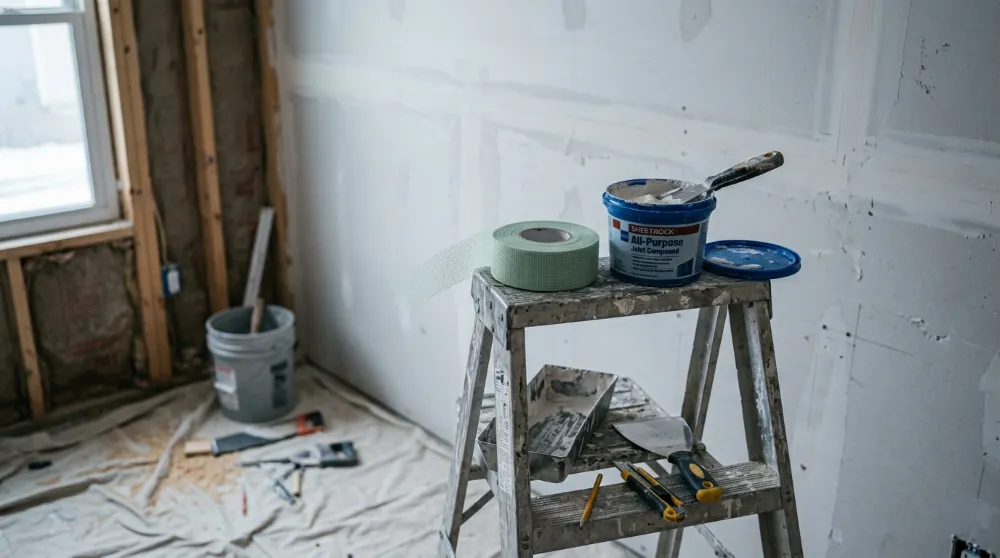
By the Calculate My Reno Team / Published
Skip to the tool
Open the Drywall Calculator
Hanging the board is half the job; the other half is taping and filling the joints. Both the mud and the tape scale with the area of board you hung, so once you know your square footage you can buy the right number of boxes and rolls.
The rules of thumb
joint compound = boarded area × 0.64 kg/m²   (~0.13 lb per sq ft)
joint tape     = boarded area × 1.2 m/m²     (~370 ft per 1,000 sq ft)
These cover a full three-coat finish - bedding, fill and skim - plus the screw heads and the corners. The drywall calculator returns both figures alongside your sheet count - and in its Cost estimate you enter the pack you’re buying (the compound’s weight, the tape roll’s length) and it works out how many packs and rolls and prices them, so the mud and tape land on the same order and the same budget.
Mud: how many boxes
A 4.5 gallon box of ready-mixed all-purpose compound weighs about 61.7 lb (28 kg) and covers roughly 475 sq ft of board for a taped, three-coat finish. So:
| Boarded area | Joint compound | Boxes |
|---|---|---|
| 250 sq ft | ~33 lb | 1 box |
| 500 sq ft | ~65 lb | 1-2 boxes |
| 1,000 sq ft | ~130 lb | 2-3 boxes |
Ready-mix in a box or pail is the easy choice for most jobs. Setting-type “hot mud” that you mix from powder sets faster and shrinks less, but it is less forgiving to sand - handy for the bedding coat or filling big gaps.
Tape: paper vs mesh
You need about 370 ft of tape per 1,000 sq ft of board, so most single rooms come in under one 250 or 500 ft roll. Two kinds:
- Paper tape - stronger, and the only choice for inside corners (it is pre-creased). Bedded into a layer of mud.
- Self-adhesive mesh - quicker to apply on flat butt and tapered joints, but should be used with setting-type compound for strength. Not for inside corners.
Worked example
A 528 sq ft room (the 12 × 12 ft example from how much drywall do I need):
- Compound: 528 sq ft × 0.13 lb = about 69 lb - just over one 4.5 gallon box.
- Tape: 528 ÷ 1,000 × 370 = about 195 ft - one roll covers it.
Buy one extra roll of tape and keep the mud box sealed between coats so it does not skin over.
Don’t forget corner bead
External corners take a metal or paper-faced corner bead rather than tape - one length per corner, set in compound. Count your outside corners separately; the calculator’s tape figure is for the taped flat and inside-corner joints. For the full materials picture and costs, see the cost to hang and finish drywall.
Frequently asked questions
How much drywall mud do I need per square foot?
Allow roughly 0.6 kg of joint compound per square metre of board for a taped, three-coat finish - that works out to about one 4.5 gallon (61.7 lb) box of ready-mix per 475 sq ft of board, or roughly 0.13 lb per square foot. A 500 sq ft room takes a little over one box. The drywall calculator works the mud total out from your boarded area.
How many rolls of drywall tape do I need?
Allow about 370 linear feet of tape per 1,000 sq ft of board (roughly 1.2 m per m²). A standard roll of paper tape is 250 or 500 ft, so most single rooms need just one roll. A whole-house job is easier to buy by the case. The calculator gives the tape length from your boarded area.
How many coats of drywall mud do you need?
Three coats is standard: a bedding coat that embeds the tape, a fill coat that builds the joint up flush, and a thin finish (skim) coat that feathers the edges out for sanding. Each coat must dry before the next. The 0.6 kg/m² allowance covers all three coats plus the screw heads and corners.
What is the difference between all-purpose and lightweight joint compound?
All-purpose (green lid) mud is strong and sticky - best for the bedding coat that holds the tape, and for setting corner bead. Lightweight or "Plus 3" (blue lid) mud weighs less, shrinks less and sands much more easily, which makes it the better choice for the fill and finish coats. Many drywallers use all-purpose to bed tape and lightweight for the top coats.