
How Much Grass Seed Do I Need?
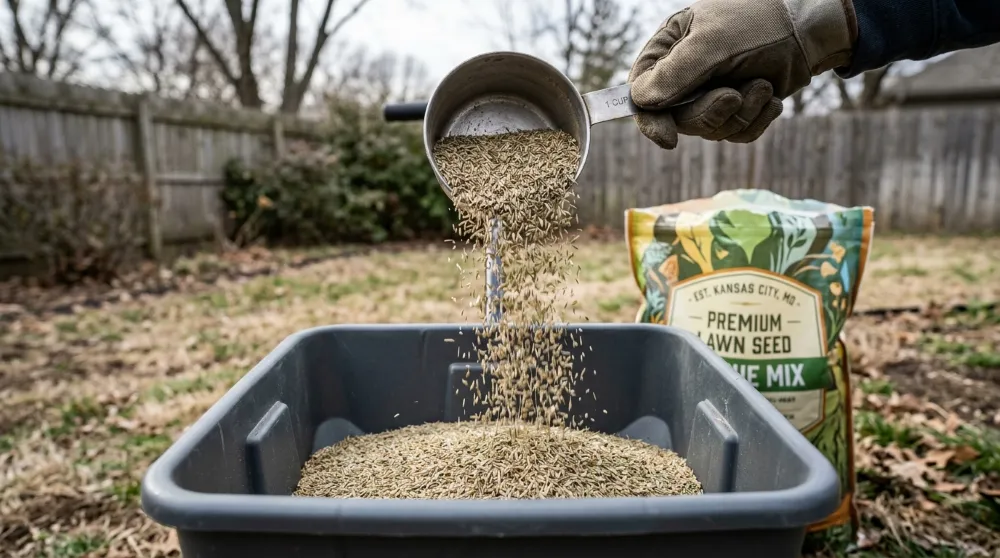
Too little seed and the lawn comes up thin and patchy; too much and the seedlings choke each other. The amount comes down to two numbers: your lawn area and the right sowing rate.
By the Calculate My Reno Team / Published
Skip to the tool
Open the Sod & Grass Seed Calculator
Grass seed is sold by weight, and the amount you need is simply your lawn area times a sowing rate. The only real decision is which rate - and that depends on whether you are starting from bare soil or thickening an existing lawn.
The formula
seed weight = area × sowing rate
bags        = seed weight ÷ bag weight (rounded up)
Keep the area and the rate on the same reference - pounds per 1,000 sq ft, or grams per square metre. The grass seed calculator (the sod calculator in seed mode) does the conversion and returns the total weight and the number of bags.
Sowing rates
| Job | Imperial | Metric |
|---|---|---|
| New lawn from bare soil | 5 - 7 lb / 1,000 sq ft | ≈ 35 g/m² |
| Overseeding an existing lawn | 3 - 4 lb / 1,000 sq ft | ≈ 25 g/m² |
A new lawn needs about twice as much seed as overseeding because it has no existing grass to fill the gaps. Rates also vary by grass type - fine fescues and ryegrass are sown heavier, Kentucky bluegrass lighter - so always check the figure printed on the bag.
Worked example
A 40 ft × 25 ft new lawn, sown at 6 lb per 1,000 sq ft:
- Area: 40 × 25 = 1,000 sq ft.
- Seed: 1,000 ÷ 1,000 × 6 = 6 lb of seed.
- From 20 lb bags: that is well under one bag - but check the bag’s own rate, as coverage differs by blend.
In metric, a 12 m × 8 m lawn at 35 g/m² is 96 × 35 = 3,360 g, or about 3.4 kg.
Don’t over-sow
It is tempting to throw down extra “to be sure”, but seed that lands too thick comes up as crowded, weak seedlings that compete for water and light and thin themselves out. Sow at the rate, spread it evenly in two passes at right angles, and keep the seedbed consistently damp until it germinates.
A few tips
- Split an irregular lawn into rectangles, add one section per area in the calculator, and it totals the seed for you.
- Sow in the right window for your grass - cool-season grasses in early autumn or spring, warm-season grasses in late spring.
- Rake the seed lightly into a fine, level seedbed and keep birds and heavy rain off it while it establishes.
- Want an instant lawn instead, with no germination wait? Compare the routes in sod vs seed.
Frequently asked questions
How much grass seed do I need per square foot?
For a brand-new lawn, sow at about 5 to 7 lb per 1,000 sq ft (roughly 35 g per square metre). For overseeding a thin existing lawn, use about half that - 3 to 4 lb per 1,000 sq ft (about 25 g per square metre). Rates vary by grass type, so check the bag: fine fescues and ryegrass are sown heavier than Kentucky bluegrass. Multiply your area by the rate to get the total weight of seed.
What is the seeding rate for a new lawn vs overseeding?
A new lawn needs roughly twice the seed of overseeding, because you are covering bare soil rather than thickening grass that is already there. New lawns run about 35 g per square metre or 5 to 7 lb per 1,000 sq ft; overseeding runs about 25 g per square metre or 3 to 4 lb. Going much heavier than the recommended rate does not help - crowded seedlings compete and thin themselves out.
How long does grass seed take to grow?
Most lawn grasses germinate in about 7 to 21 days given warmth and consistent moisture, with ryegrass at the fast end and fescues and bluegrass slower. A full, hard-wearing lawn takes a season to establish, which is the main trade-off against laying sod. Keep the seedbed damp until germination and do not let it dry out, or the rate you calculated will not all come up.