
How Much Sand Do I Need for Pavers?
A paver job uses sand twice: a leveling bed the pavers sit on, and jointing sand brushed into the gaps. They are different sands in different amounts - here is how to size both.
By the Calculate My Reno Team / Published
Skip to the tool
Open the Paver Calculator
Sand does two jobs in a paver patio, and they are easy to mix up. One is the leveling bed the pavers sit on, sized by volume. The other is the jointing sand swept into the gaps, sized by the bag. Get both right and the patio sits flat and stays locked.
The two sands
bedding (leveling) sand = paved area × bedding depth           (by volume)
jointing sand           = joint share of area × paver depth     (by the bag)
                          → weight ÷ bag size
The paver calculator sizes both. It returns the bedding sand volume straight from your area and depth, and estimates the jointing sand from the joint volume - the strip of area the paver faces leave for the joints, filled to the paver depth - then converts that to a weight and divides by your bag size to suggest a bag count. A bag’s printed coverage chart is a good cross-check.
| Sand | Where it goes | Typical amount |
|---|---|---|
| Bedding / leveling | Screeded bed under the pavers | 25-40 mm (1-1.5 in) deep |
| Jointing (kiln-dried) | Brushed into the gaps | 1 bag per ~5-10 m² |
| Polymeric | Joints, then misted to set hard | 1 bag per ~25-100 sq ft |
Bedding sand: by volume
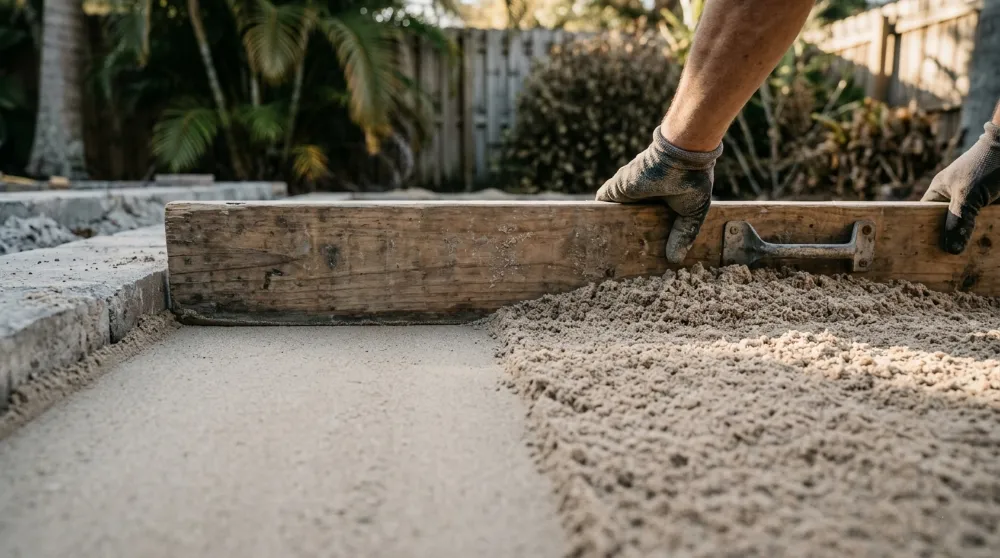
The laying course is a uniform 25-40 mm of sharp, angular sand, screeded level - that means dragging a straight edge (a board or a length of pipe set on rails) across the sand to leave a dead-flat bed before you set the pavers. Multiply your paved area by that depth:
A 20 m² patio at 30 mm: 20 × 0.03 = 0.6 m³, which is roughly 0.9 tonne of sand. Order a little extra, since some is lost screeding and tamping.
Use coarse bedding, concrete or grit sand - never soft builders or play sand, which slumps and holds water.
Jointing sand: by the bag
Once the pavers are down and compacted, the gaps are filled with kiln-dried or polymeric jointing sand. How far a bag goes depends on the joint width and how deep the pavers are - the two things that set the joint volume:
- Narrow joints, thin pavers (a tight brick patio) - the joints hold little sand, so a bag goes furthest, near the top of the range.
- Wide joints or thick pavers - deeper, wider joints hold far more sand per square metre, so a bag covers less. Large-format slabs with tight joints actually use less, as there are fewer joints per square metre.
For polymeric sand, read the bag’s coverage chart, divide your area by it, and round up. Polymeric is brushed in, then lightly misted so it sets firm and resists weeds and ants.
Worked example
A 20 m² patio, 30 mm bedding, standard 200 × 100 × 50 mm brick pavers with 3 mm joints:
- Bedding sand: 20 × 0.03 = 0.6 m³ (about 0.9 tonne).
- Jointing sand: the joints take a small share of the surface - about 4% for 3 mm joints around these pavers - and filled to the 50 mm paver depth that is ≈ 0.043 m³ ≈ 70 kg of sand, or roughly 4 × 20 kg bags (about 5 m² per bag at this joint width). Buy a spare on top. The calculator works the share out from your paver size and joint, so you don’t have to.
A few tips
- Screed the bed against rails to a dead-even depth - do not use extra bedding sand to fix a lumpy sub-base (the compacted gravel layer underneath), fix the base first.
- Keep the bedding sand dry and covered until you lay; wet sand is hard to screed flat.
- Fill the joints fully and re-sweep after a few days as the sand settles, especially with polymeric.
- Sizing the rest of the build? See how many pavers do I need and the cost to install pavers.
Frequently asked questions
How much sand do I need for pavers?
You need two lots. The bedding (leveling) sand is a screeded layer 25-40 mm (1-1.5 in) thick under the pavers - volume is area × depth, so a 20 m² patio at 30 mm is about 0.6 m³. The jointing sand that fills the gaps is bought by the bag; one 20 kg bag typically fills the joints of roughly 5-10 m² depending on joint width and paver depth.
What kind of sand goes under pavers?
Use sharp, coarse, angular sand - sold as bedding sand, concrete sand or grit sand - for the laying course, never soft builders or play sand, which holds water and slumps. It is screeded to an even 25-40 mm and the pavers are tamped into it. The gaps on top are filled separately with kiln-dried or polymeric jointing sand.
How much polymeric sand do I need?
Polymeric sand coverage depends on joint width and paver thickness. A 50 lb (about 22 kg) bag covers roughly 75-100 sq ft of standard narrow-joint brick pavers, but only 25-60 sq ft of large-format or wide-jointed pavers. Check the bag for its chart, work out your area, and divide - then buy a spare bag.
Is leveling sand the same as jointing sand?
No. Leveling (bedding) sand is the coarse screeded bed the pavers sit on, measured by volume. Jointing sand - kiln-dried or polymeric - is finer and goes into the gaps between pavers after they are laid, measured by the bag. Do not swap them: bedding sand will not lock the joints and joint sand makes a poor bed.