
AC Unit Cost
Air conditioners are quoted by the ton, and the price per ton falls as the unit gets bigger - which is the opposite of what most people expect and the first thing worth understanding before you read a quote.
By the Calculate My Reno Team / Published
Skip to the tool
Open the Home System Replacement Cost Calculator
Air conditioning is sold by the ton - a unit of cooling, not of weight - and once you know that, a quote stops being a mystery and starts being arithmetic. One ton is 12,000 BTU/h of cooling. A 4 ton unit does 48,000.
What a central AC costs, installed
| Size | Central AC, installed |
|---|---|
| 1.5 ton (18,000 BTU) | $4,700 - $6,500 |
| 2 ton (24,000 BTU) | $5,000 - $6,800 |
| 3 ton (36,000 BTU) | $5,800 - $7,800 |
| 4 ton (48,000 BTU) (the common house) | $6,500 - $8,800 |
| 5 ton (60,000 BTU) | $7,000 - $9,500 |
| Heat pump (by size, unit + basic install) | $3,500 - $8,800 |
| Ductwork: seal / repair · new whole-house | $400 - $1,900 · $2,000 - $12,000 |
Bands are indicative 2026 US contractor ranges from published cost guides (HomeGuide, Angi). They are not a quote.
Read that table again: the price per ton falls
This is the part almost nobody explains, and it changes how you read a quote.
1.5 ton:  $4,700 - $6,500  ÷ 1.5  =  ~$3,100 - $4,300 per ton
5   ton:  $7,000 - $9,500  ÷ 5    =  ~$1,400 - $1,900 per ton
More than double the cooling for well under double the money. The reason is simple: a big slice of an AC job is the same work whatever hangs off the end of it - the trip, the line set, the electrical, the permit, the labor of getting the old unit out and the new one in. The box scales. The job does not.
So a contractor quoting a flat $/ton figure across sizes is not quoting the job as it is actually done, and a quote that looks cheap per ton on a big unit is not a bargain - it is arithmetic.
Efficiency moves it again
SEER2 is the efficiency label on the box, and all you need to know is that a higher number means less electricity for the same cooling. 13.4 is roughly the entry level; 20 and up is the premium end.
| Efficiency | Condenser, installed |
|---|---|
| SEER2 13.4 (the entry tier) | $5,300 - $7,900 |
| SEER2 20+ | $11,400 - $17,300 |
That is a genuine doubling for the same tonnage. Whether it pays back depends on your climate, your electricity price and how long you will own the house - in a hot, long cooling season it can; in a mild one it is a long wait. Price it, do not assume it.
Bigger is not safer - the one thing to take away
The estimating rule is one ton per 500 sq ft, so a 2,000 sq ft house prices at about 4 tons. Use it to price the job. Then stop using it, because it systematically oversizes - ACCA’s own data puts real Manual J load calculations nearer 1,400 sq ft per ton than 500.
And an oversized air conditioner is a worse air conditioner. Not more expensive-but-fine. Worse:
- It cools the air faster than it dehumidifies it. Pulling moisture out takes run time, and a big unit satisfies the thermostat and shuts off before it has had any.
- The house ends up cold and clammy rather than cool and dry - which is the feeling people blame on the unit being too small, and then oversize again.
- It short-cycles - runs in short bursts and shuts off again - which is hard on a compressor.
That is why cooling should be rounded to the nearest size actually built - and there is no 4.5 ton unit; the line goes 4, then 5 - while heating rounds up. Two opposite rules, both deliberate. Furnace replacement cost covers the other one.
How the price is built
tons = floor area ÷ (sq ft per ton)  → round to the NEAREST size built

ac unit cost = tons × $ per ton
             + ductwork (seal, repair or new)
             + line set, electrical, pad
             + permit and inspection
             + removal of the old condenser
The calculator sets that $ per ton from the size you land on - reloading it as the size changes, because the rate genuinely moves - and lets you type over it, which is how you price a high-efficiency unit. Run yours through the AC replacement cost calculator for a low-typical-high band, then price the lines locally.
What moves the total
- Tonnage, which should come from a load calculation, not from the floor plan.
- Efficiency tier, which roughly doubles the condenser between the bottom and the top.
- The ductwork. Undersized or leaking ducts throttle a new unit and are the reason some houses never feel fixed.
- The indoor coil. A condenser is rated as a matched pair with the coil it feeds - a new outdoor unit on an old indoor coil does not deliver its rated efficiency.
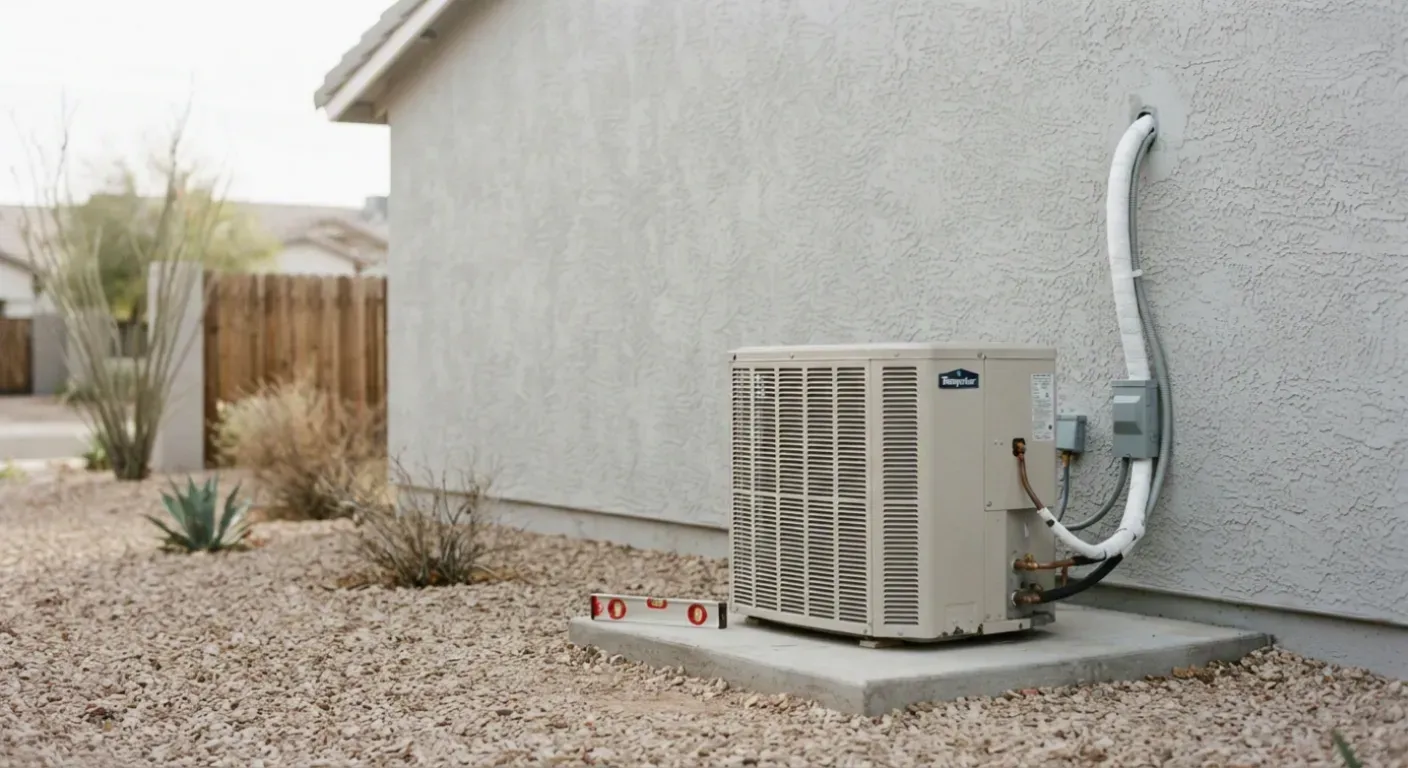
- Access. A ground-level condenser on a concrete pad against an accessible wall is the easy version of this job.
- A heat pump instead, which cools and heats and is priced $3,500 to $8,800 by size for the unit and a basic install.
Worked example
A 2,000 sq ft house replacing a dead central AC.
- Size for pricing: 2,000 ÷ 500 = 4 tons → $6,500 - $8,800 installed at the entry efficiency tier.
- Get the Manual J done anyway. At ACCA’s real-world average nearer 1,400 sq ft per ton, this house may genuinely need closer to 3 tons - which is a $5,800 - $7,800 unit, and a better-performing one.
- Step 2 saved money and improved the result. That is the whole argument for the load calculation, in one line.
- Add the ducts if they leak ($400 - $1,900), the permit, and the removal.
The rule of thumb sold you a bigger machine that works worse. Do not let it.
Where AC quotes go wrong
- Sizing off square footage. It oversizes. It is a pricing shortcut, not a design.
- “Go one size up to be safe.” There is no safe direction here. Up is cold and clammy.
- Paying for a SEER2 20+ condenser feeding leaking ducts. The ducts are cheaper and matter more.
- Mixing a new condenser with an old indoor coil and expecting the rated efficiency. They are rated as a pair.
- Budgeting on a tax credit without checking it still exists. The US federal 25C credit was repealed for anything placed in service after 31 December 2025 (One Big Beautiful Bill Act, P.L. 119-21), and Canada’s Greener Homes Grant is closed. Check before you count on it.
If the furnace is the same age as the AC, price the pair before committing to either - HVAC replacement cost is the full-system version of this page.
Frequently asked questions
How much does a new AC unit cost?
Installed, roughly $4,700 to $9,500 depending on size. A 1.5 ton central AC runs about $4,700 to $6,500 fitted, 2 ton $5,000 to $6,800, 3 ton $5,800 to $7,800, 4 ton $6,500 to $8,800 and 5 ton $7,000 to $9,500. Efficiency moves it on top of that: a SEER2 13.4 condenser is about $5,300 to $7,900 where a 20+ one is $11,400 to $17,300. A heat pump, which cools and heats, runs about $3,500 to $8,800 by size for the unit and a basic install.
What size air conditioner do I need?
The rule of thumb is one ton of cooling per 500 sq ft of conditioned floor, so a 2,000 sq ft house comes out around 4 tons. That figure is fine for pricing the job and useless for buying one. ACCA's own data shows real room-by-room load calculations average nearer 1,400 sq ft per ton than 500 - the rule systematically oversizes - and the size that should be installed comes from a Manual J calculation (CSA F280 in Canada), which the codes require by name.
Is a bigger AC unit better?
No, and this is the most useful thing on this page. An oversized air conditioner cools the room before it has run long enough to pull the humidity out of the air, then satisfies the thermostat and shuts off. The house ends up cold and clammy rather than cool and dry, the compressor short-cycles, and you paid more for the privilege. Cooling is the one size you should round to the nearest unit built, not up.
How much does AC replacement cost per ton?
It is not a flat rate, which is why the number is worth understanding rather than quoting. At 1.5 tons you are paying roughly $3,100 to $4,300 per ton; at 5 tons roughly $1,400 to $1,900 per ton. The price per ton falls as the box gets bigger because a large slice of the job - the trips, the line set, the electrical, the labor of getting the old one out - is the same work whatever hangs off the end of it. A contractor quoting you one flat $/ton figure across sizes is not quoting the job as it is actually done.
Should I replace the furnace at the same time as the AC?
Often yes, and not for a discount. The indoor evaporator coil sits in the furnace airflow, and the outdoor condenser is rated as a matched pair with that coil - so a new high-efficiency condenser hung off an old indoor coil will not deliver the efficiency you paid for. If the furnace is also near the end of its life, doing both means one set of trips, one permit and one matched system. HVAC replacement cost prices the pair.