
HVAC Replacement Cost
A full HVAC replacement is quoted as one frightening number, and it is really three: the furnace, the condenser, and whatever the ducts need. Split the quote into those three and it becomes something you can actually compare.
By the Calculate My Reno Team / Published
Skip to the tool
Open the Home System Replacement Cost Calculator
“HVAC replacement” arrives as one number with a comma in it, and that is exactly why it is hard to judge. It is three numbers: the furnace, the condenser, and whatever the ductwork needs. Make every quote show you those three, and a $9,000 quote and a $19,000 quote stop being suspicious and start being different scopes.
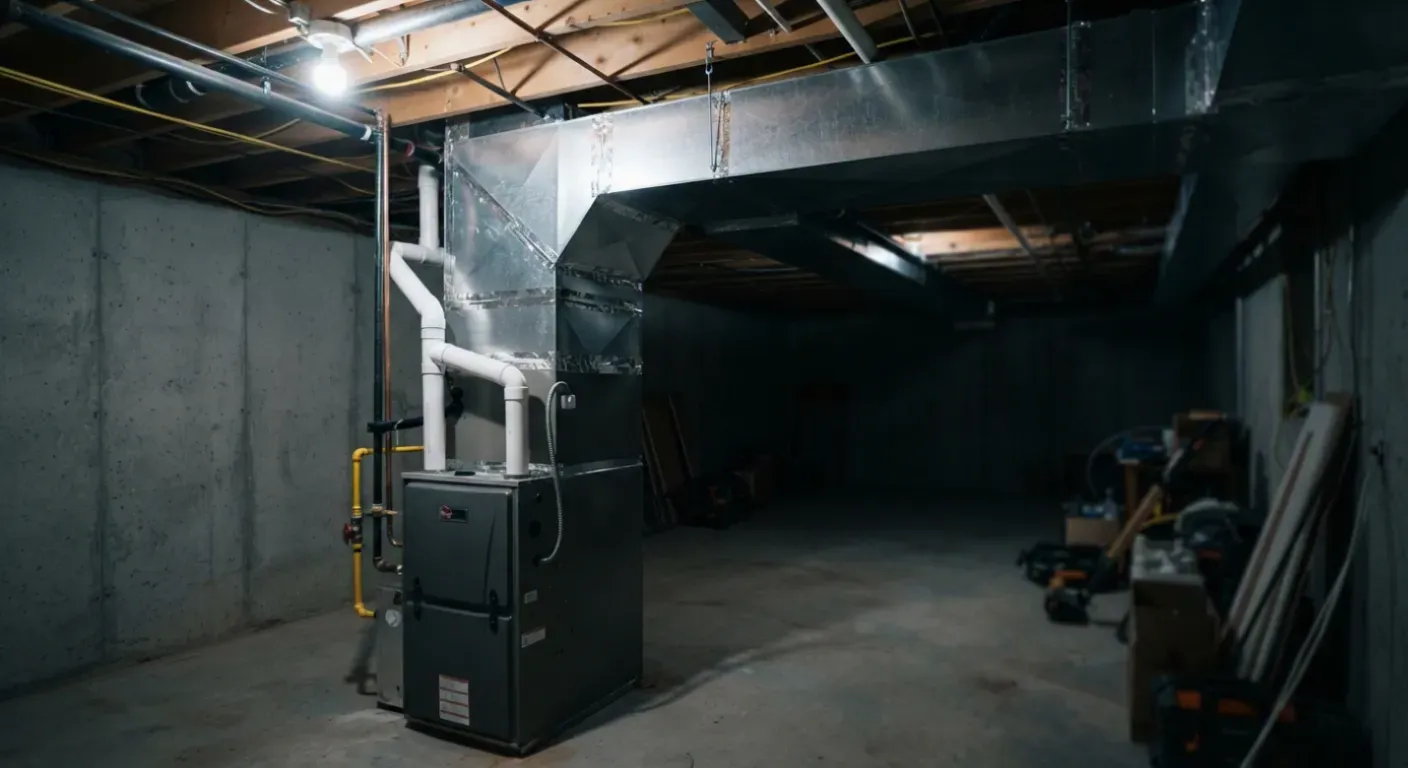
The four words a quote will use, in plain English. The furnace is the box that makes heat, usually in the basement. The condenser is the unit that sits outside and makes the cold. The coil is the part inside the furnace that the cold actually comes off, which is why the two halves are joined at the hip. The ductwork is the sheet-metal that carries any of it to your rooms.
What a full system costs
| The line | Installed |
|---|---|
| Central AC condenser (by ton) | $4,700 - $9,500 |
| Gas furnace (by BTU output) | $3,800 - $12,000 |
| Heat pump instead of both (by size, + basic install) | $3,500 - $8,800 |
| Ductwork: seal / repair | $400 - $1,900 |
| Ductwork: new whole-house | $2,000 - $12,000 |
| Full furnace + AC replacement | $7,400 - $22,000 |
Bands are indicative 2026 US contractor ranges from published cost guides (HomeGuide, Angi). They are not a quote.
Priced properly, the common house is two numbers side by side: a 4 ton condenser at $6,500 - $8,800 and an 80,000 BTU/h furnace at $5,100 - $9,500. Everything above and below that comes from size, efficiency and ducts.
Where the $15,000 spread actually comes from
Three levers, in the order they move the money:
- The ductwork. New whole-house ductwork is $2,000 to $12,000 and it is the single biggest reason two quotes disagree. One contractor is replacing boxes; the other is replacing the system that distributes what the boxes make.
- Efficiency. An 80% AFUE furnace is $3,800 - $6,200 installed where a 96%+ condensing one is $7,500 - $12,000. A SEER2 13.4 condenser is $5,300 - $7,900 where a 20+ one is $11,400 - $17,300. Both roughly double. (AFUE is the share of the gas that becomes heat; SEER2 is the AC’s efficiency rating - higher is less electricity. Furnace and AC explain each.)
- Size, which should come from a load calculation - and which, done properly, often comes back smaller than the rule of thumb said.
None of those three is “brand.” Brand is what the quote leads with and it is the least of your worries.
Why the pair, and not just the broken one
The technical reason is worth understanding, because it is the one argument for doing both that is not a sales pitch: the indoor evaporator coil sits in the furnace’s airflow, and the outdoor condenser is rated as a matched pair with that coil. Hang a new high-efficiency condenser off a fifteen-year-old indoor coil and it will not deliver the efficiency printed on it. You bought the SEER2 number and installed something less.
That is a real argument when both units are near the end. It is not an argument when one of them has years left in it - and a contractor who cannot tell you which case you are in is selling, not diagnosing. If only the heating side is failing, furnace replacement cost is your page; if only the cooling side, AC unit cost is.
The heat pump alternative
A heat pump does both jobs with one machine - $3,500 to $8,800 by size for the unit and a basic install - which is why it keeps appearing in quotes as the cheaper road. Two honest caveats before you take it:
- A cold-climate installation may still want backup heat, which is a second line item, not an afterthought.
- The electrical service has to carry it. In an older house with a small panel, “add a heat pump” quietly means “and upgrade the panel,” which is $1,300 to $3,000 for the common 100 A to 200 A job. That is not a reason not to do it. It is a reason to find out before you compare it against a furnace.
How the price is built
tons  = floor area ÷ (sq ft per ton)   → round to the NEAREST size built
BTU/h = floor area × BTU per sq ft     → round UP to the next furnace built

hvac replacement cost = tons  × $ per ton
                      + BTU/h × $ per 1,000 BTU
                      + ductwork (seal, repair, or new)
                      + permit, electrical, removal of the old units
Both rates seed from the size you land on and can be typed over, which is how you price a high-efficiency system rather than an entry one.
The two rounding rules go in opposite directions, and both are deliberate: an oversized condenser is a worse machine (it satisfies the thermostat before it has dehumidified, and leaves the house cold and clammy), while a furnace that cannot keep the house warm on the coldest night it was sized for is simply not big enough. Run the house through the HVAC replacement cost calculator to get both sizes and a low-typical-high band on each.
The sizing rule oversizes, and the fix is cheap
The estimating rules - one ton per 500 sq ft of cooling, 40 BTU/h per sq ft of heating - exist to price a job, not to design one. A 2,000 sq ft house prices at 4 tons and 80,000 BTU/h. Fine for a budget.
But ACCA’s own data shows real Manual J load calculations average nearer 1,400 sq ft per ton than 500. The rule of thumb systematically oversizes, and the codes have never asked for it: a room-by-room load calculation - Manual J in the US, CSA F280 in Canada - is what the codes require by name, and it accounts for your insulation, your windows and your air leakage rather than your floor area alone.
Get it done before anyone orders equipment. It is the cheapest part of an HVAC job and the only part that decides whether the expensive parts were the right size. It routinely lands on a smaller, cheaper, better-performing system - which is precisely why it is the step most often skipped.
Worked example
A 2,000 sq ft house, furnace and AC both original and both failing, ducts intact.
- Cooling: 2,000 ÷ 500 = 4 tons → $6,500 - $8,800 installed.
- Heating: 2,000 × 40 = 80,000 BTU/h → $5,100 - $9,500 installed.
- Ducts: intact, so seal and repair at $400 - $1,900 while everything is open. Do not skip this because it is small - it is the line that makes the other two work.
- Running total: roughly $12,000 - $20,200, inside the $7,400 - $22,000 envelope, and toward the top of it because this is a full system.
- Now do step zero. Get the Manual J. If it comes back at 3 tons and 60,000 BTU/h - which at ACCA’s real-world figures is entirely plausible - the same house is $5,800 - $7,800 + $4,200 - $7,200, a system that dehumidifies properly and several thousand dollars cheaper.
The load calculation is the only line on the quote that pays for itself twice.
Where HVAC quotes go wrong
- Comparing two quotes with different duct scopes. Ducts swing the number by up to $12,000. Make each quote show them separately.
- Buying efficiency to compensate for leaking ducts. The ducts are cheaper and they are the actual problem.
- Sizing off the floor area. It oversizes, and on the cooling side an oversized unit is a worse unit.
- Replacing both when only one is failing - or replacing one when the coil makes it a false economy. Ask which case you are in and make them explain it.
- Pricing a heat pump without pricing the panel. Find out before you compare, not after.
- Budgeting on a tax credit without checking it still exists. The US federal 25C credit was repealed for anything placed in service after 31 December 2025 (One Big Beautiful Bill Act, P.L. 119-21), and Canada’s Greener Homes Grant is closed. What is left is state and provincial, and some of it has already run out of money. Check before you count on it.
If the water heater is the same vintage as the furnace, price it in the same conversation - see water heater replacement cost.
Frequently asked questions
How much does HVAC replacement cost?
A full furnace-and-AC replacement lands roughly between $7,400 and $22,000, and the spread is size, efficiency and ductwork rather than brand. Priced properly it is two numbers side by side: a 4 ton condenser is about $6,500 to $8,800 installed and an 80,000 BTU/h furnace about $5,100 to $9,500. A heat pump instead of both runs about $3,500 to $8,800 by size for the unit and a basic install. New whole-house ductwork adds $2,000 to $12,000; sealing and repairing what you have adds $400 to $1,900.
Why is the range on HVAC replacement so wide?
Because "HVAC replacement" is not one job. At the bottom of the range is an entry-efficiency furnace and condenser swapped into a house whose ducts are fine. At the top is a high-efficiency matched system in a house that needs new ductwork - and the ductwork alone can be $12,000. Before comparing two quotes, make each one show you the furnace, the condenser and the ducts as three separate lines. Two honest contractors quoting different scopes will look thousands apart.
Should I replace the furnace and AC at the same time?
If both are near the end of their lives, usually yes - and the reason is technical, not commercial. The indoor evaporator coil sits in the furnace airflow and the outdoor condenser is rated as a matched pair with it, so a new high-efficiency condenser hung off an old coil will not deliver the efficiency it was sold with. Doing both at once also means one permit, one set of trips and one disruption. If only one is failing and the other has years left, replacing just the failing one is a perfectly reasonable answer.
Is a heat pump cheaper than a furnace and AC?
On the unit, often - a heat pump runs about $3,500 to $8,800 by size for the unit and a basic install, and it does both jobs, so you are buying one machine rather than two. The honest caveats are that a cold-climate installation may still want backup heat, and that the electrical service has to carry it, which is where an old panel becomes part of the conversation. Price the whole picture, including the panel, before deciding it is the cheaper road.
How much does new ductwork cost?
Sealing and repairing existing ductwork is $400 to $1,900. New whole-house ductwork is $2,000 to $12,000 - which is why it is the single biggest reason two HVAC quotes disagree. It is also the line most worth spending on: a high-efficiency system pushing air through leaking ducts delivers neither the comfort nor the bills it promised, and the ducts are cheaper than the efficiency upgrade that is trying to compensate for them.