
How to Cut Stair Stringers
The stringer is the saw-tooth board that carries the whole staircase. Mark it wrong and every step is off. Here is how to lay one out and cut it accurately.
By the Calculate My Reno Team / Published
Skip to the tool
Open the Stair Calculator
The stringer is the notched board that the treads and risers sit on - the backbone of the staircase. Cutting one accurately is mostly careful marking with a framing square.
Before you start: get your numbers
You need your riser height and tread depth (the going), worked out from the total rise - see stair rise and run explained. The stair calculator gives you these and draws the profile, so you can mark the stringer with confidence.
Step 1: Set up the framing square
On a straight, knot-free board (usually a 2×12):
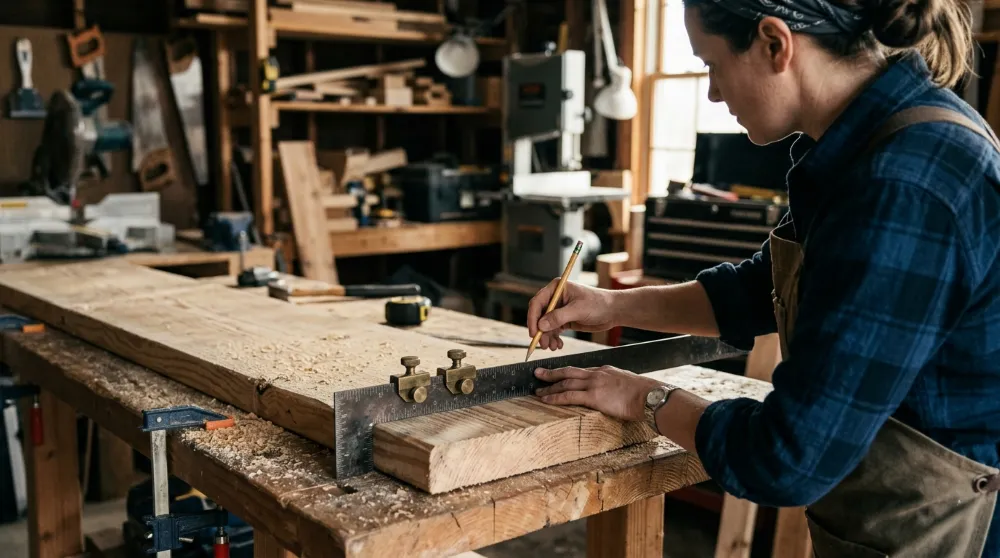
- Clamp stair gauges (the little brass buttons) to the framing square - one at your riser height on the tongue (short arm), one at your tread depth on the blade (long arm).
- Slide the square along the top edge of the board so both gauges touch the edge. That single position marks one step - the riser up the tongue, the tread along the blade.
Step 2: Step off the flight
Mark around the square, then move it along so the next step starts where the last tread mark ended. Repeat for the full number of steps. Keep each placement tight to the edge - small drifts add up over a flight.
Step 3: Mark the top and bottom cuts
- Top: a vertical plumb cut where the stringer meets the upper floor or header.
- Bottom: a horizontal seat cut where it lands on the base.
Step 4: The all-important deduction
Trim the bottom of the stringer by one tread thickness. This “dropping the stringer” keeps the first step level with the rest once the treads are fitted. Forget it and your bottom step is one tread-thickness too tall - the classic stringer error and a trip hazard.
Step 5: Cut
Cut the notches with a circular saw, stopping on the line, and finish the inside corners with a handsaw or jigsaw so you do not overcut and weaken the board. Use the first stringer as a template for the rest.
How many stringers
Space them no more than ~16 in (400 mm) apart. A standard ~36 in (900 mm) stair needs three (two outers, one centre); wider stairs need more so treads do not flex.
Next
Building exterior steps off a deck? The same stringer method applies, plus footings and ledger fixing - see how to build deck stairs, and check your geometry first with the stair calculator.
Frequently asked questions
What is the stair stringer deduction?
After cutting the saw-tooth, you trim the bottom of the stringer by the thickness of one tread board. This "dropping the stringer" keeps the first step the same height as all the others once the treads are on - skip it and your bottom step ends up one tread-thickness too tall. It is the most common stringer mistake.
How many stringers does a staircase need?
Space stringers no more than about 16 inches (400 mm) apart. A standard residential stair (around 36 in / 900 mm wide) usually needs three stringers - two outers and one centre. Wider stairs or thinner treads need more, to stop the treads flexing underfoot.
What size timber do I use for stringers?
Commonly a 2×12 (or 38 × 235 mm and up), because the saw-tooth cuts remove a lot of material and the remaining "throat" must stay strong. Keep at least about 5 inches (125 mm) of uncut depth behind the notches, and use a straight, knot-free board.