
How to Space Stair Balusters
Balusters have to be evenly spaced and close enough that a small child cannot slip through. Here is how to calculate baluster spacing and count, the 4-inch (100 mm) gap rule, and the simple formula that makes every gap identical.
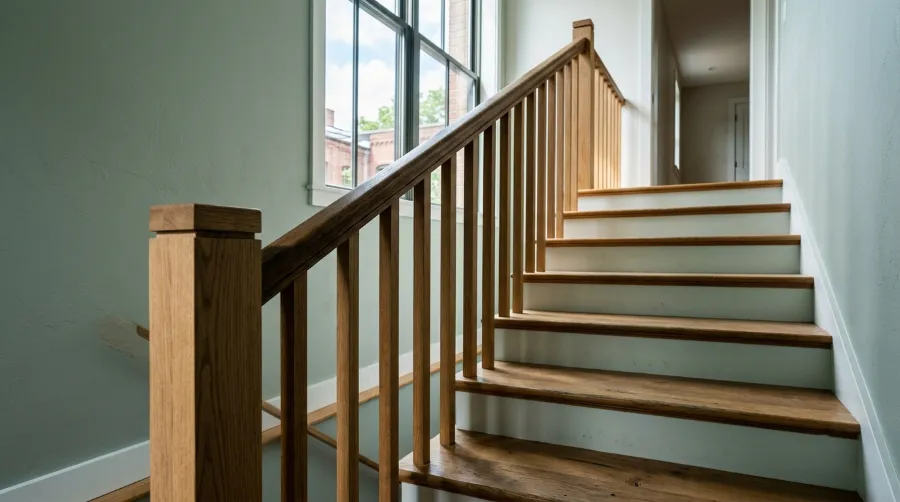
By the Calculate My Reno Team / Published
Skip to the tool
Open the Stair Calculator
Balusters (also called spindles) are the uprights that fill the guard - the protective barrier, or railing, between the handrail and the stair or landing that stops anyone falling off the side. Two things decide their layout: they must be evenly spaced so the run looks right, and the gaps must be small enough that a small child cannot slip or climb through. Get the gap rule first, then the spacing falls out of it.
The gap rule (size the gap, not the spacing)
Every code sizes baluster gaps by the 4-inch sphere rule: a sphere of a set diameter must not pass through any opening in the guard.
| Region | Maximum gap (clear space) |
|---|---|
| 🇺🇸 US (IRC) | < 4 in (100 mm); 4 3/8 in at the open triangle on stair treads |
| 🇨🇦 Canada (NBC) | < 100 mm (about 3 7/8 in) |
| 🇬🇧 UK (Approved Doc K) | < 100 mm |
| 🇦🇺 Australia (NCC) | < 125 mm (gaps), with extra rules where a fall exceeds 4 m |
| 🇳🇿 New Zealand | < 100 mm |
Design to under 4 in (100 mm) and you are safe almost everywhere. The number that matters is the clear gap between balusters, not the centre-to-centre spacing - so you always work the gap out after allowing for the width of each baluster.
The even-spacing formula
For a run of railing between two newel posts - the thick anchor posts at the top, bottom and any turn of the stair that the handrail fixes to - there is always one more gap than baluster (a gap at each end against the posts):
gaps      = balusters + 1
gap size  = (clear run − balusters × baluster width) ÷ (balusters + 1)
So the method is:
- Measure the clear run between the newel posts.
- Pick your baluster width (a 1.5 in / 38 mm square spindle is typical).
- Start with a baluster count and work out the gap. If the gap is 4 in (100 mm) or more, add one baluster and recalculate.
- The first count that brings every gap under the limit is your answer - and because the maths divides the leftover evenly, every gap comes out identical.
The stair calculator gives you the rail lengths and tread count to feed into this; size the balusters once you have the run.
Worked example
A landing rail with a 1500 mm clear run between posts, using 38 mm square balusters, target gap under 100 mm:
- Try 11 balusters: gap = (1500 − 11 × 38) ÷ 12 = (1500 − 418) ÷ 12 = 90.2 mm ✓
- Try 10 balusters: gap = (1500 − 380) ÷ 11 = 101.8 mm ✗ (over 100 mm)
So 11 balusters gives 12 equal 90 mm gaps - under the limit and evenly spaced.
In imperial, the same idea: a 59 in run with 1.5 in spindles aiming for under 4 in needs 11 balusters - gap = (59 − 16.5) ÷ 12 = 3.54 in ✓.
Spacing balusters on the rake (stairs)
The rake is the sloped, diagonal part of the stair - the run of railing that climbs alongside the steps. On this sloped section the gap is measured horizontally, the same as on the level - a 4 in sphere still must not pass through. The neat trick most builders use is two balusters per tread, spaced evenly across the going. That keeps the gaps consistent up the whole flight and lines the spindles up with the steps. Check the widest gap with the formula above using the horizontal tread depth (the going) as the run for one tread, minus two baluster widths.
How many balusters in total
- Level rail: divide the clear run as above, then add the run lengths from each rail section.
- Stairs: about two balusters per tread - so a 13-tread flight needs roughly 26.
- Newel posts are counted separately, one at each change of direction, top and bottom.
Add a few spare - the offcuts and the odd split spindle are normal on a fitting day.
Watch out for
- The bottom rail gap. The space under the bottom rail is also an opening - keep it under the same 4 in (100 mm) limit.
- Climbability. Some codes (notably Australia) restrict horizontal rails or footholds between 150 mm and 760 mm where a child could climb the guard. Vertical balusters avoid this.
- Guard height. Separate from spacing: guards are typically 36 in (US) / 900 mm (UK, NZ) / 1 m (Australia) high on stairs, higher on balconies. Confirm yours locally.
Next
Work out the staircase itself first - rise, run, treads and stringers - with the stair calculator, then come back to space the balusters along the rail. Building outside? See how to build deck stairs, which uses the same guard and spacing rules.
Frequently asked questions
How far apart should balusters be?
The gap between balusters must not let a 4-inch (100 mm) sphere pass through, so the clear space between spindles is kept under 4 in (100 mm) in the US and Canada, and under 100 mm in the UK, Australia and New Zealand. In practice that means a centre-to-centre spacing of about 4 in plus one baluster width - so around 5 to 5.5 in (125-140 mm) for a typical square spindle. Always size the gap, not just the spacing, and use the tightest gap your design produces.
How do I calculate even baluster spacing?
Take the clear run between the newel posts, decide a maximum gap (under 4 in / 100 mm), and find the smallest number of balusters that keeps every gap below it. Gaps = balusters + 1. So gap = (run - balusters x baluster width) / (balusters + 1). Increase the baluster count until that gap drops under the limit, then every gap is identical. The formula does this for you.
How many balusters do I need per foot or per metre?
With a 4 in (100 mm) maximum gap and a 1.5 in (38 mm) square spindle, you get roughly two balusters per foot, or about six to seven per metre. On stairs you usually fit two balusters per tread to keep the gaps even on the rake. Multiply by the rail length (or the number of treads) for the total, and add the newel posts separately.
What is the 4-inch sphere rule?
Building codes size guard openings by whether a sphere can pass through them, because a gap is only dangerous if a child can fit through it. A 4-inch (100 mm) sphere must not pass between balusters, below the bottom rail, or through any part of a guard. On open stair treads the US allows a slightly larger 4 3/8 in (111 mm) sphere at the triangular opening, but 4 in is the safe number to design to.