
Mold Remediation Cost
Mold remediation is priced by the area affected and by how much containment the job needs - and a small patch is a genuinely different job from a whole basement. But the number that decides whether the money was worth spending is not on the quote at all: it is the water source.
By the Calculate My Reno Team / Published
Skip to the tool
Open the Basement Waterproofing Cost Calculator
Mold remediation is priced by the area affected and by how much containment the job needs. But the most important line in this guide is not about price at all: mold is a moisture problem wearing a costume. Remediate without fixing the water, and you have bought a delay.
The water source is the job
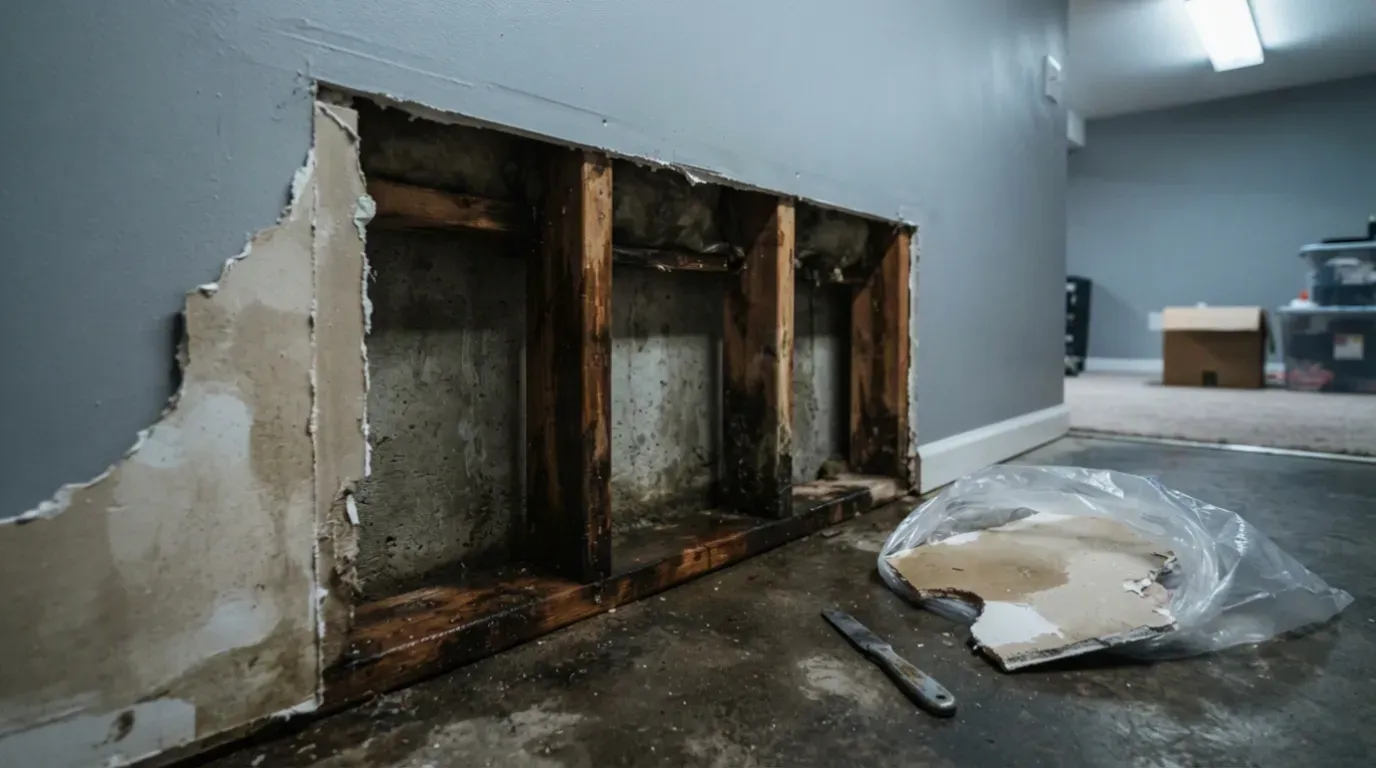
Mold does not arrive on its own. Something is wet - a leaking pipe, a roof, a failed seal, condensation, or a basement taking on water. The remediation cleans up the consequence. If the cause is still running, it grows back, and you will pay twice.
So the order is:
- Find the water. A wet basement is the classic source - see basement waterproofing cost.
- Stop the water.
- Then remediate.
A remediation quote that shows no interest in where the water came from is quoting you half a job.
How the price is built
mold remediation cost = affected area (sq ft) × rate for the containment tier
                      + removal of porous material (drywall, insulation, carpet)
                      + testing, if it is needed at all
                      + fixing the water source  ← the line that actually matters
The rate is not flat across sizes - it steps up with the tier, because sealing a room and running negative air pressure costs much the same at the bottom of a tier as at the top.
The tiers, and why they are the whole price
| Tier | 🇺🇸 US (EPA) | 🇨🇦 Canada (Health Canada) | What the crew has to do |
|---|---|---|---|
| DIY | Under ~10 sq ft | 1 m² or less | Normal precautions, ordinary cleaning. Most people handle this themselves. |
| Contained | ~10-100 sq ft | Between 1 m² and 3 m² | Seal the area, protective gear, HEPA vacuuming, bag the waste before it leaves the room. |
| Full containment | Over ~100 sq ft | A single patch over 3 m² | Sealed enclosure under negative air with HEPA filtration, respirators, controlled disposal. |
The thresholds are not the same on both sides of the border, so use the column that applies to you. Both are rules of thumb about area rather than laws, and neither is about how alarming the patch looks.
The remediation itself runs roughly $10 to $25 per sq ft of affected area (about $110 to $270 per m²), with most residential jobs landing between $1,200 and $3,750. Bands are indicative 2026 contractor ranges from published cost guides (Angi, This Old House, HomeGuide, Today’s Homeowner) and are not a quote.
Regardless of size, it is not a DIY job if: it involves sewage or contaminated water, it is inside a wall cavity, or it has reached the HVAC system - because that last one distributes it through the house.
The step between tiers is where the money is. Doubling the patch inside a tier costs a bit more; crossing into full containment changes what the crew has to bring, and the number moves in a step.
What moves the total
- The containment tier. The biggest lever, and it is set by the area.
- Porous material. Drywall, insulation and carpet cannot be cleaned - they get cut out and replaced. Mold on a hard surface is cleaned; mold in drywall is demolition.
- Access. Inside a wall or under a floor means opening it up and closing it back.
- Reinstatement. What comes out has to go back. On a finished basement this is a real second bill.
- Testing, if you actually need it - see the FAQ, because often you do not.
Worked example
A basement wall with mold across roughly 40 sq ft of drywall after a wet winter:
- Fix the water first. Interior seepage along that wall is a waterproofing job, and nothing below is worth buying until it is done.
- Tier: 40 sq ft (about 3.7 m²) puts it in the contained tier under EPA guidance, and over Health Canada’s 3 m² line - sealed area, protective gear, bagged waste. Not DIY, not full containment.
- 40 sq ft × $10-$25 = roughly $400 - $1,000 for the remediation itself, though a contractor minimum call-out usually floors a job this small.
- The drywall is porous, so it is coming out - add the cut-out and the haul-away.
- Reinstatement: new drywall, tape, and paint on that wall.
- Skip the testing unless you cannot find the source or you need a clearance result for someone else.
Note that steps 4 and 5 can rival step 3. Half of what you are paying for is demolition and rebuilding, not mold.
Where mold quotes go wrong
- Remediating without fixing the leak. It regrows. This is the whole ballgame.
- Paying to test what you can already see. If it is visible, testing rarely changes the plan.
- Using a company that both tests and remediates, without at least noticing the conflict.
- Assuming mold on drywall can be cleaned. Porous material comes out.
- Forgetting reinstatement. The wall has to go back.
Frequently asked questions
How much does mold remediation cost?
About $10 to $25 per square foot of affected area, with most residential jobs landing between $1,200 and $3,750. But the size drives more than the price - it drives the method. A small patch is a clean-up you can do yourself. Once the area grows, the crew has to seal the room, run negative air, wear respirators and bag the waste, and the number steps up sharply, because you are paying for the containment rather than for the cleaning. Measure the patch before you ring anyone.
How big does mold have to be before I call someone?
It depends which side of the border you are on, because the guidance differs. In the US, the EPA treats under about 10 sq ft as a job a homeowner can handle, 10 to 100 sq ft as a contained job, and over 100 sq ft as full containment with negative air. In Canada, Health Canada treats 1 m² or less as a small area you can clean yourself, and a single patch over 3 m² as a large area needing professional assessment. Either way it is a rule of thumb about area, not a law - and it is not a DIY job at any size if it involves sewage, sits inside a wall cavity, or has reached the HVAC system.
Why is mold remediation priced per square foot?
Because the labor scales with the surface that has to be cleaned or cut out and the material that has to be bagged and hauled. But the per-square-foot rate is not flat - it steps up with the containment level, since sealing a room, running negative air and wearing full protection costs the same whether the patch is at the low end of that tier or the high end. Ask any quote which tier it is pricing.
Do I need mold testing?
Often not, and this is where people spend money for nothing. If you can see mold, you already know you have mold, and testing it rarely changes what gets done about it - the remediation is the same either way. Testing earns its keep when you cannot find the source, when you are in a dispute with a landlord, insurer or seller, or when you want a clearance test afterward. Be wary of a company that both tests and remediates, since it is being asked to diagnose the problem it sells the cure for.
Will the mold come back?
If the water source is still there, yes - reliably. Mold is a symptom of moisture, not a cause, and remediation without fixing the leak is money spent on a problem that is going to regrow. This is the single most important thing to understand about the whole category: the leak is the job, and the cleanup is the consequence.