
Fence Types Compared
The fence you pick changes the materials, the price and how you estimate it. Here is a plain comparison of the common types - wood, vinyl, chain link, privacy and picket - and the calculator settings that suit each.
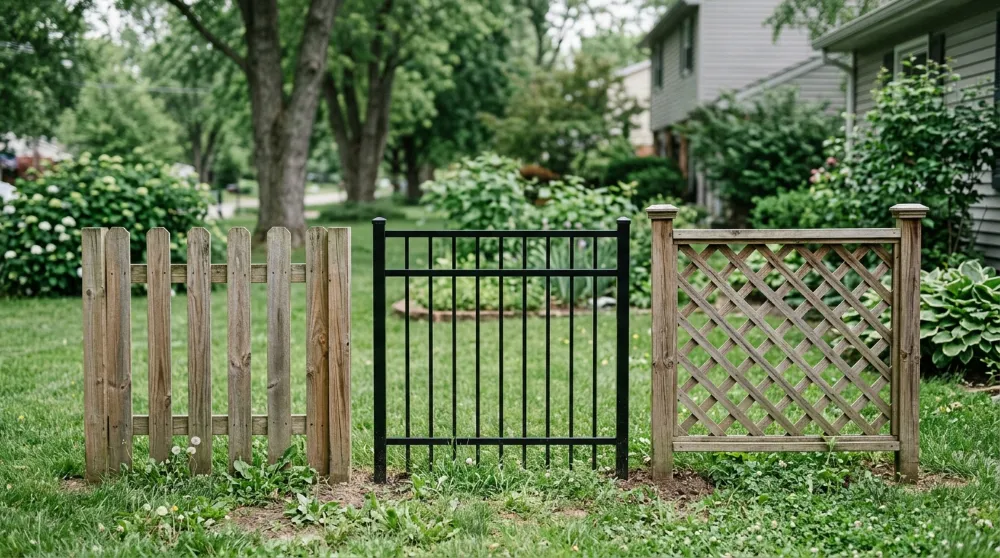
By the Calculate My Reno Team / Published
Skip to the tool
Open the Fence Calculator
There is no single best fence - it depends on whether you want privacy, looks, security or the lowest price. The build method and the way you estimate it differ by type, so pick the type first.
The common types
| Type | Best for | Cost | Upkeep |
|---|---|---|---|
| Chain link | Security, lowest cost | Lowest | Very low |
| Picket | Decorative, low boundary | Low-mid | Re-stain |
| Close-board / privacy | Privacy, screening | Mid | Re-stain |
| Board-on-board | Two-sided privacy | Mid-high | Re-stain |
| Panel (pre-made) | Fast install | Mid | Re-stain |
| Vinyl / composite | Low upkeep, long life | Highest | Very low |
How the type changes the estimate
Most timber and vinyl fences are built the same way - posts, rails and cladding - so the same fence calculator handles them; you just change the inputs:
- Privacy / close-board: set the gap between boards to zero so they butt together, and use 3 rails for a tall fence.
- Board-on-board: also a zero gap, but allow extra boards for the overlap.
- Picket: set the gap equal to the picket width for the classic even spacing, with 2 rails on a low fence.
- Panel fences: set the post spacing to the panel width so each bay holds one panel.
- Horizontal: boards run side to side between posts; count board rows by the fence height instead of pickets by the run.
Chain link is the odd one out - it is mesh rather than boards, so you count posts, a top rail and the run length of mesh rather than pickets.
Choosing between them
- Want to save money? Chain link, or a simple close-board timber fence.
- Want privacy? Close-board, board-on-board or a solid panel - gap zero.
- Want it to look good from the street? A picket fence or a quality panel.
- Want least upkeep? Vinyl or composite, accepting the higher up-front cost.
A few tips
- Match the post spacing to your panels if you buy pre-made - it saves cutting and odd gaps.
- Heavier boards (privacy, board-on-board) want closer posts and 3 rails so the fence does not sag.
- Whatever you pick, price it from the material list rather than a per-foot rate.
- Then count the posts and pickets for your chosen style.
Frequently asked questions
What is the cheapest type of fence?
Chain link is usually the cheapest per foot - it is posts, a top rail and a roll of mesh, with no cladding to buy by the board. Pressure-treated timber picket and panel fences sit in the middle, while vinyl, composite and hardwood cost the most up front but need less upkeep.
What is the difference between a privacy fence and a picket fence?
A privacy fence has no gap between the boards (close-board or board-on-board) and is usually tall, so you cannot see through it. A picket fence has spaced pickets - often a gap equal to the picket width - and is lower and decorative. In the calculator, set the gap to zero for privacy and to the picket width for a classic picket look.
What is a board-on-board fence?
Board-on-board overlaps each board over the edge of the next, so there is no gap even as the timber shrinks - a solid, two-sided privacy fence. It uses more boards than a simple close-board fence for the same run because of the overlap, so add for that when counting pickets.
Which fence type lasts the longest?
Vinyl and composite fences last longest with the least upkeep - no rot, no repainting - though they cost more at the start. Pressure-treated and naturally durable timber lasts well if it is kept off the ground and re-stained every few years. Chain link's galvanised or coated steel lasts a long time but offers no privacy.