
Types of Pavers Compared
Pavers come in concrete, clay brick and natural stone, in sizes from a slim Holland brick to a 16 × 16 in slab, laid in a handful of patterns. Here is how the types compare and how each one changes the count you buy.
By the Calculate My Reno Team / Published
Skip to the tool
Open the Paver Calculator
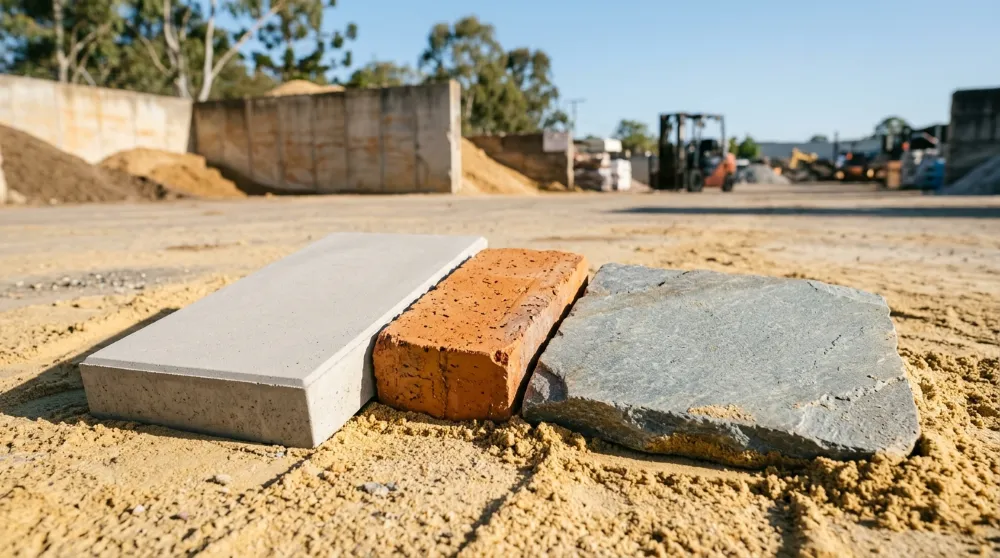
“Paver” covers a lot of ground - a slim clay brick, a chunky concrete driveway block, a big stone slab. They are laid the same way, on sand over a compacted base, but the material, the size and the pattern all change what you buy. Here is how they compare.
The three families
| Type | Cost | Best for |
|---|---|---|
| Concrete | Lowest | Patios, paths, driveways - any size and colour |
| Clay brick | Mid | Traditional warm-red paths and patios that keep colour |
| Natural stone | Highest | Premium patios - flagstone, granite, bluestone |
Concrete is the default for most jobs: cheapest, strongest range of sizes, and colours to suit. Clay brick costs more but holds its colour for decades. Natural stone is the most expensive and the slabs vary in thickness, so it takes more skill to lay flat.
Block and Holland pavers
Block pavers - the small interlocking rectangular units, often the 200 × 100 mm Holland size - are concrete pavers built for traffic. Laid in a tight herringbone they interlock and spread load, which is why they suit driveways and busy paths. They use more pieces per square metre than big slabs, but the small format takes curves and cuts cleanly.
Common sizes
The size is what sets your count, so measure the paver before you estimate:
| Size | Per m² | Per sq ft |
|---|---|---|
| 200 × 100 mm (8 × 4 in) | ~50 | ~4.5 |
| 12 × 12 in (300 mm) | ~11 | 1.0 |
| 16 × 16 in (400 mm) | ~6.3 | ~0.56 |
| 18 × 18 in (450 mm) | ~4.9 | ~0.44 |
| 24 × 24 in (600 mm) | ~2.8 | ~0.25 |
These are nominal, before joints and wastage. Enter your exact size in the paver calculator for the real count - see how many pavers do I need for the full method.
Laying patterns
The pattern changes the look and the cutting wastage:
- Running / stack bond - simplest, least waste (~5%).
- Offset / basketweave - classic, moderate waste (~10%).
- Herringbone (I-pattern) / 45-degree - strongest interlock for driveways, most waste (10-15%) from the angled edge cuts.
A note on retaining walls
Searching for “retaining wall pavers”? Those are segmental retaining wall blocks - thick units stacked into a vertical wall and counted by the wall face area and course height, not by floor area. This calculator and these guides size flat paving; a retaining wall is a separate count.
A few tips
- Match the paver to the job: thin pavers for a patio, thicker vehicle-rated block for a driveway.
- Buy one batch and one colour run; concrete and clay both vary slightly between lots.
- Choose herringbone for anything cars drive on - the interlock is what stops the pavers creeping.
- Once you have picked a type, size the order with how many pavers do I need and the bed with how much sand do I need for pavers.
Frequently asked questions
What are the main types of pavers?
The three families are concrete pavers (the cheapest and most common, in every size and colour), clay brick pavers (the traditional warm-red brick that keeps its colour), and natural stone (flagstone, granite, bluestone - the priciest). Within concrete you also get block or Holland pavers, the small rectangular interlocking units used for driveways and paths.
What size are pavers?
Common sizes run from a 200 × 100 mm (8 × 4 in) brick or Holland paver up to square slabs of 12 × 12 in, 16 × 16 in, 18 × 18 in and 24 × 24 in, plus rectangular formats like 6 × 9 in. The size sets how many you need per square metre or foot, so enter your exact paver dimensions in the calculator rather than assuming a count.
Are retaining wall blocks the same as pavers?
No. Retaining wall blocks are thick segmental units stacked to build a vertical wall, sized by the wall face area and course height, not by floor area. Flat pavers are laid on a sand bed over a horizontal area. This paver calculator sizes flat paving; a retaining wall is counted by wall area and is a separate job.
Which paver pattern wastes the most?
Herringbone and any 45-degree diagonal (sometimes called an I-pattern) waste the most because the perimeter is full of angled cuts - allow 10-15%. Running bond and stack bond waste the least at about 5%, and basketweave or offset sits around 10%. Pick the layout in the calculator and it adds the matching allowance.